


Mexican Peso (MXN) – Exchange Rate and Currency Exchange in Warsaw
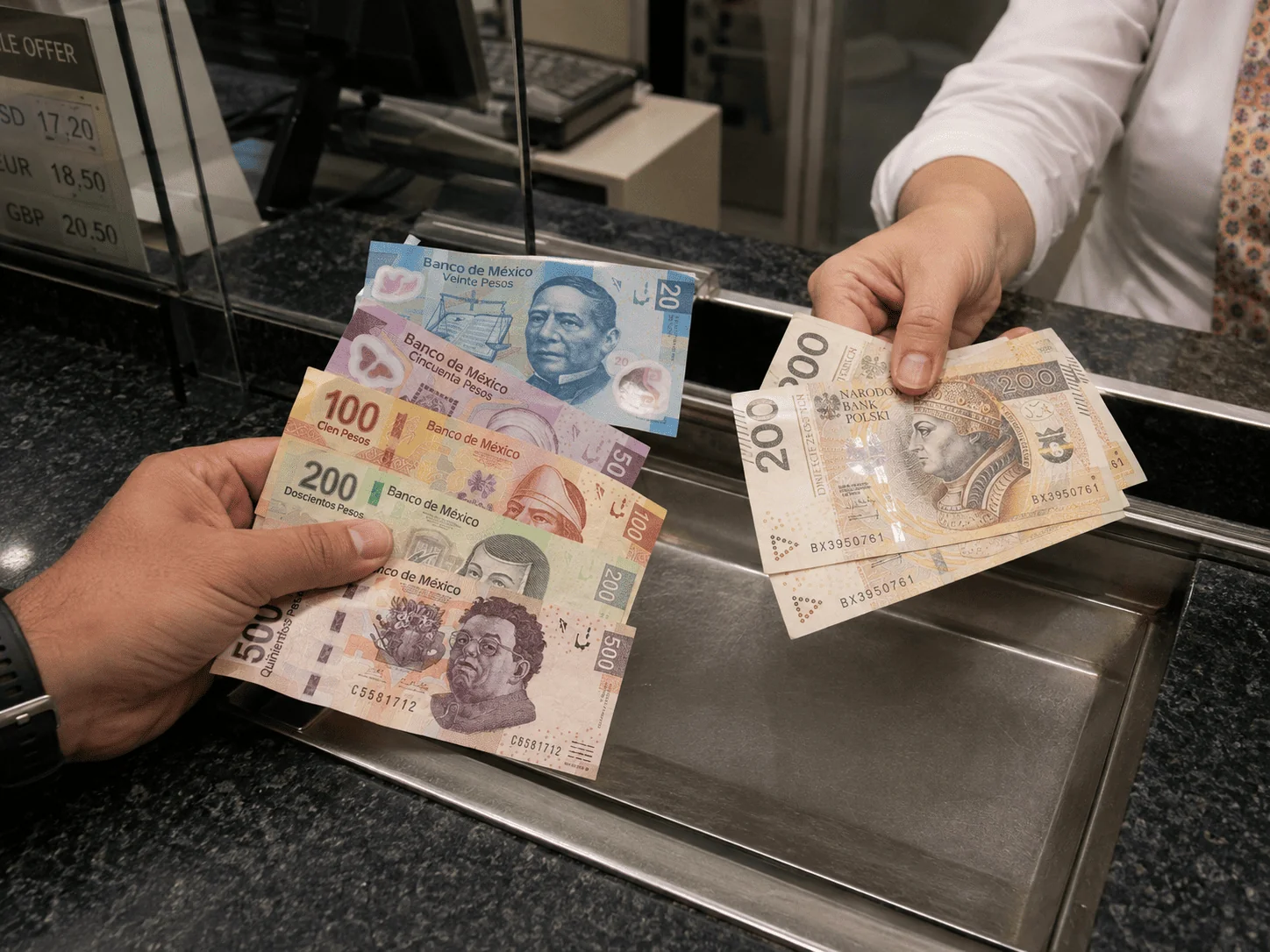
We exchange Mexican pesos (MXN) for Polish złoty and złoty for pesos at the Argentarii exchange office at Grzybowska 61 in the Wola district of Warsaw. The rate is on the board before you reach the counter, and it is the same for 200 pesos as it is for 20,000.
The peso is an exotic currency in Poland. Few exchange offices carry it and banks usually want an order placed several days in advance. Pesos are a permanent part of our offer, both for people flying to the Yucatán and for those coming back with cash left in the wallet. For a larger amount or specific denominations, call a day ahead on +48 791 901 979 and we will have the cash ready at an agreed time.
MXN/PLN rate
1 MXN = 0.2000 zł

Buying rate from this page. It is more favourable than the rate on the board in our branch, ask the cashier for it.
The currency you want to receive is temporarily out of stock. Rate reservation is unavailable. We buy this currency as usual, swap the direction to calculate.
A reservation holds the rate for 60 minutes. The rate from this page does not cover small denominations, damaged notes, old series or coins.
Today’s Mexican peso rate (MXN/PLN)
Our buy and sell rates for the peso are published on the agkantor.pl home page and updated during opening hours. At the counter, ask for the rate from this page: it is more favourable than the board. The rate is the same regardless of the amount.
The reference point for the peso is the National Bank of Poland mid rate. MXN sits in table A, published every business day. The latest quote at the time of writing is 0.2173 PLN per peso (table 152/A/NBP/2026 of 7 August 2026).
There is a trap here that catches comparison sites and scripts pulling NBP data automatically. Table B still holds an old entry for the peso: 0.2318 PLN, dated 24 December 2007. Nobody ever removed that quote, and it is almost seven percent above the current one. If you see a peso rate noticeably better than the rest of the market, check the date of the table before you count on it. Only table A is current.
How much is 100 pesos and how many pesos for 100 złoty
The conversions below use the NBP mid rate of 0.2173 (7 August 2026, table 152/A/NBP/2026). Buy and sell rates at the counter differ from the mid rate, so treat these figures as a reference rather than an offer.
At the NBP mid rate, 1 MXN = 0.2162 zł (table 188/A/NBP/2026 of 28 September 2026), which means 1 zł = 4.6253 MXN.
At the Argentarii exchange office at Grzybowska 61 we buy MXN today at 0.2000 zł; selling this currency is temporarily unavailable (updated 07.07.2026, 07:30).
| Amount | At NBP rate | You sell to us: you receive | You buy from us: you pay |
|---|---|---|---|
| 10 MXN | 2.16 zł | 2.00 zł | n/a |
| 50 MXN | 10.81 zł | 10.00 zł | n/a |
| 100 MXN | 21.62 zł | 20.00 zł | n/a |
| 500 MXN | 108.10 zł | 100.00 zł | n/a |
| 1,000 MXN | 216.20 zł | 200.00 zł | n/a |
| Amount in zł | At NBP rate | You buy from us: you receive |
|---|---|---|
| 100 zł | 462.53 MXN | n/a |
| 500 zł | 2,312.67 MXN | n/a |
| 1,000 zł | 4,625.35 MXN | n/a |
Amounts are indicative and the rate changes during the day; at the counter the rate at the moment of the transaction applies. The website rate is more favourable than the rate on the board in our branch, ask the cashier for it. It does not cover small denominations, damaged notes, old series or coins.
The other way round: 100 PLN gets you roughly 460 pesos, 500 PLN about 2,300 pesos and 1,000 PLN about 4,600 pesos. One złoty is worth roughly 4.6 pesos.
The quickest way to convert in your head on the spot is to divide the peso amount by five. A 350-peso bill comes out at about 70 PLN, against 76 PLN in reality, so the shortcut understates the price by some nine percent and leaves you a margin. Multiplying by five works in reverse: 40 PLN is about 200 pesos.
Watch out for the Spanish way of writing amounts. Mil means “thousand”, so 2 mil pesos is 2,000 pesos, roughly 435 PLN, and not two million. A million pesos is un millón.
Mexican peso versus the other pesos
“Peso” is not one currency but a name used in a dozen Latin American countries and in the Philippines. The notes can look alike while the values differ enormously, so before you come to the counter, check the name of the central bank printed on the note.
- Mexican peso (MXN) – issued by Banco de México, and the words “Banco de México” appear on every note. This is the only peso we exchange.
- Argentine peso (ARS) – Banco Central de la República Argentina, a completely different value and a completely different inflation history.
- Philippine peso (PHP) – Bangko Sentral ng Pilipinas, with text in English and Filipino.
- Colombian (COP), Chilean (CLP), Dominican (DOP), Cuban (CUP) and Uruguayan (UYU) pesos – each with its own central bank and its own rate.
All of them use the symbol $, the same one as the dollar. A price of “$250” in Cancún means 250 pesos, about 54 PLN, not 250 dollars. Mexicans sometimes add MN or M.N. for moneda nacional to remove the doubt, but not everywhere.
At Argentarii we exchange the Mexican peso. We do not carry the other pesos. The full list of currencies we carry is on our currency exchange page.
The 50 peso gold coin and the 50 peso banknote are two different things
A search for “50 pesos” leads to two entirely different objects, and it is worth separating them, because the difference in value is roughly a thousandfold.
The 50 peso banknote is ordinary legal tender with a face value of fifty pesos, about 11 PLN. The current version from 2021 is polymer, violet, and carries an axolotl from the Xochimilco canals on the reverse. The International Bank Note Society named it Bank Note of the Year for 2021, with the award announced in April 2022. Mexico had taken the same award the year before, for 2020, with the 100 peso note showing Sor Juana Inés de la Cruz and the monarch butterfly.
The 50 peso gold coin, known as the Centenario, is a different category altogether. First struck in 1921 for the centenary of Mexican independence, it contains 37.5 g of pure gold (1.20565 troy ounces) at a fineness of 0.900, with a total weight of 41.67 g and a diameter of 37 mm. The reverse shows the Winged Victory from the Angel of Independence monument against the Iztaccíhuatl and Popocatépetl volcanoes. Minting stopped in 1931 and resumed in 1943; the later restrikes from 1949 to 1972 almost all carry the date 1947.
The legal difference matters. Under article 2 bis of the Mexican monetary law, the Centenario and the other coins in its family have no face value. Their worth is set by the daily bullion quote, which Banco de México publishes. The words “50 pesos” are effectively the coin’s name rather than its price.
If you hold a Centenario, an Azteca (20 pesos), a Hidalgo (10 pesos) or a silver Libertad, that is not a job for the currency counter. We value them through our coin buying service in Warsaw and our gold buying service, by weight and fineness of the metal, and the valuation on site is free.
What currency is used in Mexico
The currency of Mexico is the Mexican peso, ISO code MXN. It divides into 100 centavos and is issued by Banco de México, the central bank that gained its autonomy on 1 April 1994.
Today’s peso is younger than it looks. On 1 January 1993 Mexico redenominated its currency: the nuevo peso was introduced at 1 new peso = 1,000 old pesos and the ISO code changed from MXP to MXN. The word “nuevos” and the N$ symbol disappeared from the notes in 1996. Old pesos from families AA and A lost legal tender status; Banco de México lets you exchange them free of charge at any bank, indefinitely, at the same thousand-to-one ratio, as long as at least half of the note survives.
The peso also holds a place in monetary history that is hard to miss. The silver peso, the old Spanish real de ocho struck in the Americas, was the model for the US dollar: the Coinage Act of 1792 defined the dollar by the value of the Spanish milled dollar. The $ symbol itself most likely comes from the abbreviation “ps” for pesos, where the s gradually came to sit over the p. Mexican silver circulated across Asia as well, and in the nineteenth century prices in Chinese ports were regularly quoted in “dollars mex”.
What moves the peso against the złoty
MXN/PLN is not quoted directly. The peso to złoty rate is calculated through the dollar, so two things act on the price of pesos in Poland at once: what happens to USD/MXN, and what happens to the dollar against the złoty. The peso can strengthen against the dollar and lose ground against the złoty at the same time, if the złoty is rising faster.
The peso has floated freely since 22 December 1994, when the tequila crisis drained the central bank’s reserves defending a trading band and the rate had to be released. Since then Banco de México defends no particular level and steers through the policy rate instead.
The main drivers:
- The interest rate gap with the United States. The Banxico target rate stands at 6.50 %, set on 7 May 2026 when the easing cycle ended, and held at the meetings of 25 June and 6 August 2026. For comparison, at the end of 2023 it was 11.25 %. A high rate against a lower US rate pulls capital into the peso.
- Trade with the United States. Mexican exports reached 664.8 billion dollars in 2025, up 7.6 % year on year, with more than 80 % going to the US (INEGI data published 27 January 2026). Every change to the USMCA and every new tariff shows up in the rate within hours.
- Remittances from Mexicans working in the US. They came to 61.79 billion dollars in 2025 against 64.75 billion in 2024, a fall of 4.6 % (Banco de México, published 3 February 2026). That runs against the common assumption that remittances only ever grow. In the first half of 2026 they returned to growth, up 3.1 % year on year.
- Risk appetite on global markets. The peso is one of the most liquid emerging market currencies, so it tends to be sold first when investors move away from risk, regardless of what is happening inside Mexico.
The scale of that liquidity shows in the BIS survey published on 30 September 2025. The peso accounts for 1.6 % of global foreign exchange turnover and ranks 14th among all currencies and third among emerging market currencies, behind only the Chinese yuan and the Indian rupee. Daily peso turnover is around 153 billion dollars, 35 % more than three years earlier. Among Latin American currencies, the peso is the most traded.
The peso from 2024 to 2026: from super peso to recovery
The last three years show how quickly the peso can move, which is worth knowing if you are planning a trip well in advance.
Until the middle of 2024 the market spoke of the “super peso”. The rate dropped towards 16.30 per dollar and on 5 April 2024 it broke through 16.50, the strongest level since 2015. The carry trade drove it: the rate gap between Mexico and the US was unusually wide at the time.
The turn came from politics. After the election of 2 June 2024 the peso began to weaken, and on 6 November, the day Donald Trump won, it lost about three percent in a single session and moved towards 20.60. It closed the year at 20.88 per dollar, down 18 %. Another blow came on 2 February 2025, when the rate reached 21.27 in the Asian session after tariffs were announced.
The peso then recovered and closed 2025 at 18.00 per dollar, a gain of 13.7 %, its best year since 1994. In 2026 the rate has been stable: the low was 17.0866 on 18 February, and on 7 August 2026 the Banco de México FIX rate stood at 17.1387. The peso has gained about 4 % since the start of the year. NBP rates from the same day imply 17.18 pesos per dollar, and the small difference comes from NBP fixing its rates before the main Mexican session opens.
The practical takeaway for a traveller is that the peso reacts to the political calendar in the United States more than to anything inside Mexico. If your trip is months away, it is worth splitting the exchange into two or three tranches rather than converting everything on one day.
Buying and selling pesos in Warsaw
We buy and sell Mexican pesos, both ways, with no split into “we only buy” and “we only sell”. Before the trip you can buy cash for the first few days here; after you come back you can sell whatever is left in your wallet.
To answer the question that comes up most often: yes, you can buy Mexican pesos in Poland, you just need to know where. Banks usually require an order placed several days ahead and most exchange offices do not carry the currency at all. It is a permanent part of our offer, though for amounts in the tens of thousands of pesos, or for specific denominations, it is better to call a day ahead on +48 791 901 979.
We also exchange more than twenty other currencies, including ones that are hard to find in Warsaw – Japanese yen, Korean won, Thai baht Vietnamese dong Canadian dollars and Australian dollars.
Which Mexican banknotes we accept
The denominations in circulation are 20, 50, 100, 200, 500 and 1,000 pesos. The current G family arrived gradually: 500 pesos in September 2018, 200 pesos in September 2019, 100 and 1,000 pesos in November 2020, and the 50 and the commemorative 20 in the autumn of 2021. The 20, 50 and 100 are polymer; the higher denominations are cotton paper.
The older F family stayed in circulation alongside it, and that is usually what comes back from Mexico in a tourist’s wallet. Banco de México states plainly that notes in the process of withdrawal retain their legal tender status. There is no cut-off date for them; they simply do not return to circulation once they reach a bank. We accept notes from both families, G and F.
Two things are worth checking before you come to the counter:
- The paper 20 peso note of the F family, blue, showing Benito Juárez, in circulation since 2007, is being withdrawn under Banxico circular 8/2025 published in the official gazette on 10 October 2025. It keeps its value and banks must accept it, but it no longer returns to circulation. The 20 peso denomination is being replaced by a coin.
- Old pesos from before the 1993 redenomination (families AA and A) are no longer legal tender. They can only be exchanged at Mexican banks, at a thousand old for one new, with no deadline. We do not buy those notes, because there is no way to settle them from Warsaw.
We do not accept coins in any currency. The cost of settling them exceeds their value, so small change is best spent before you leave. In Mexico that is a noticeable loss, because coins there go up to 20 pesos, more than 4 PLN. Worth knowing too: new 10 and 20 peso coins entered circulation on 21 January 2026, and the 20 is twelve-sided with the Kukulkán pyramid of Chichén Itzá on the reverse.
We do not accept damaged, torn, taped or written-on notes.
How many pesos you can bring into and out of Mexico
Article 9 of the Mexican customs law sets the threshold at 10,000 US dollars or the equivalent. Above that amount a declaration is required, both on entry and on exit.
The detail most people miss is that the threshold is counted across all means of payment together. The law lists cash, domestic and foreign cheques, payment orders and any other document for collection, “or a combination of them”. There is no separate limit for pesos and another for euros; the total is what counts. Carrying larger sums is legal, and it is the failure to declare that is penalised; the official customs declaration form refers to sanctions of 20 to 40 % of the amount above the threshold.
Cash or card in Mexico
Mexico remains a cash country, though the share of cash is slowly falling. According to the ENIF 2024 survey run by INEGI and CNBV, 85 % of people pay cash for purchases up to 500 pesos, against 90 % in 2021, and 73 % do so above 500 pesos, against 79 % three years earlier. Five hundred pesos is about 109 PLN, so the survey threshold corresponds roughly to a larger everyday purchase.
In hotels, chain stores and resort restaurants a card works without trouble. The trouble starts outside them: at markets, in small eateries, in a colectivo, at the entrance to an archaeological site and with guides, cash is often the only option.
As for paying in dollars, the law is on the side of the peso. Article 8 of the Mexican monetary law says that obligations in a foreign currency to be settled in Mexico are met by paying the equivalent in national currency at the rate in force at the place and on the date of payment. A merchant is under no obligation to accept dollars, and if they do accept them, they set the rate themselves and it is rarely a good one. Paying in pesos means paying the price on the tag.
When paying by card, watch the settlement currency. The terminal or ATM likes to offer conversion into your home currency on the spot. That is DCC, where the rate is set by the terminal operator rather than by your bank. Always choose settlement in pesos.
The tip, or propina, is not compulsory in Mexico but is widely expected in restaurants and usually runs at 10 to 15 % of the bill. Since the amendment to the consumer protection law of December 2025, a venue cannot add the tip to the bill without the customer’s explicit consent. It helps to keep 20 and 50 peso notes for that, because getting change for a 500 can be a problem.
How the exchange works at our counter
The exchange takes a few minutes. You come to the counter, say how much you want to exchange and in which direction, and we convert it at the board rate, or at the more favourable rate from this page if you ask for it. You see the rate before the transaction, not after it. For larger sums we are bound by anti-money-laundering rules and will ask for an identity document. The office operates on the basis of an entry in the NBP register of currency exchange activity.
Notes are checked in a counter with an authenticity test. The Mexican polymer denominations are convenient in that respect, with transparent windows, tactile marks for blind users and a colour-shifting element that changes when tilted.
If you want certainty about the rate before you arrive, you can reserve it free of charge for one hour through the contact form. The reservation commits you to nothing.
Argentarii exchange office – Grzybowska 61, Warsaw
The office is at Grzybowska 61 in the Platinum Towers complex in Wola, a few minutes on foot from Rondo Daszyńskiego. Phone: +48 791 901 979. The address and opening hours are on our contact page.
We serve customers in Polish, English, Ukrainian and Russian. We do not accept payment cards. There is parking on site, and the entrance is wheelchair accessible.
Besides currency exchange we run gold buying in Warsaw – 585, 750 and 999 fineness, scrap, bars and coins, including the Mexican Centenario. Valuation on site is free. We also sell investment gold bars from 1 g to 100 g. The euro rate and the rest of our currencies are on the home page.
Frequently asked questions about exchanging Mexican pesos
How much is 100 pesos in złoty?
At the NBP mid rate of 7 August 2026 (table 152/A/NBP/2026), 100 pesos is about 21.73 PLN. At the same rate 200 pesos is about 43 PLN and 1,000 pesos about 217 PLN. Buy and sell rates at the counter differ from the NBP mid rate; the current one is on the agkantor.pl home page.
How many pesos will I get for 1 złoty?
One złoty is worth about 4.6 pesos, so 100 PLN gets you roughly 460 pesos and 1,000 PLN about 4,600 pesos. To convert the other way in your head, divide the peso amount by five; the result will be about nine percent low.
Can you buy Mexican pesos in Poland?
Yes, though not everywhere. Banks usually require the currency to be ordered several days in advance and most exchange offices do not carry pesos at all. At the Argentarii office at Grzybowska 61 in Warsaw the currency is a permanent part of our offer. For a larger amount or specific denominations, call a day ahead on +48 791 901 979.
How much is 500 pesos worth?
At the NBP mid rate of 7 August 2026 the 500 peso note is worth about 108.65 PLN. It is the highest denomination a tourist normally gets from an ATM in Mexico, and also the one that causes trouble with small purchases, so it is worth breaking it early in small venues and at markets.
Is 50 pesos a gold coin?
The name 50 pesos covers two different things. The 50 peso banknote is ordinary legal tender worth about 11 PLN. The 50 peso gold coin, the Centenario struck since 1921, contains 37.5 g of pure gold at 0.900 fineness and, under the Mexican monetary law, has no face value at all, since its worth is set by the bullion quote. We value coins through our gold and coin buying service rather than at the currency counter.
Which Mexican banknotes do you accept?
We accept circulating denominations from 20 to 1,000 pesos, both from the current G family and from the older F family, which still holds legal tender status. We do not buy old pesos from before the 1993 redenomination, because they lost that status and can only be exchanged at Mexican banks. We do not accept coins in any currency.
Can you pay in US dollars in Mexico?
A merchant is under no obligation to accept them. Article 8 of the Mexican monetary law states that obligations in a foreign currency settled in Mexico are met in national currency at the rate of the day of payment. In practice some tourist venues do take dollars, but at their own and usually unfavourable rate. Paying in pesos means paying the price shown on the tag.