


Vietnamese dong (VND) exchange rate – buying and selling dong in Warsaw
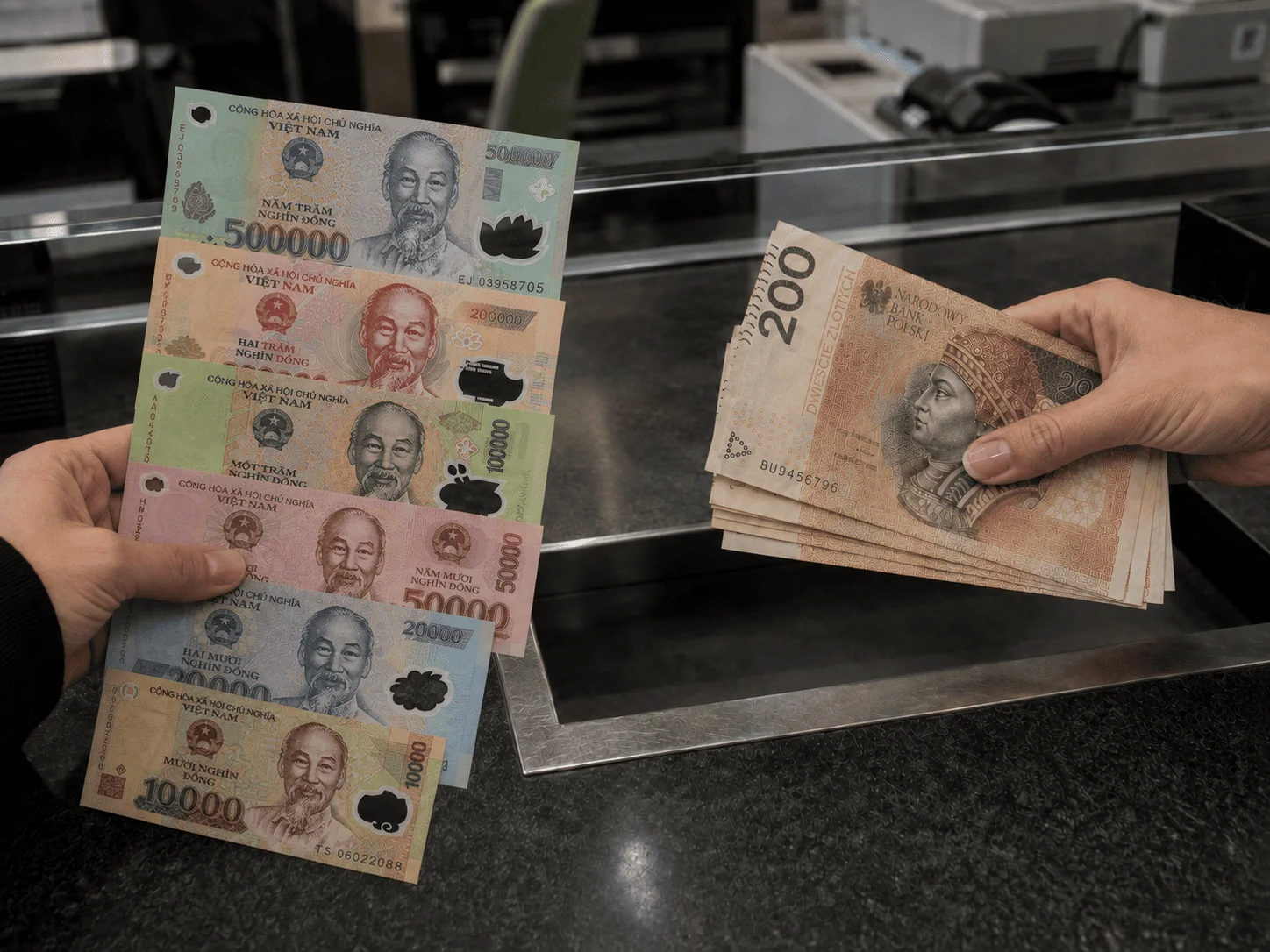
The Vietnamese dong (VND), written đồng in Vietnamese, is the currency of the Socialist Republic of Vietnam, issued by the State Bank of Vietnam. At the Argentarii exchange office at Grzybowska 61 in Warsaw you can buy dong before flying to Hanoi or Ho Chi Minh City and sell whatever is left in your wallet when you get back.
The office is in the Platinum Towers complex in the Wola district, a few minutes from Rondo Daszyńskiego. Buy and sell rates for VND are shown on the board above the counter and on the agkantor.pl home page. At the window, ask for the rate from this page: it is more favourable than the board. We add no commission or conversion surcharge.
VND/PLN rate
1 VND = 0.0001 zł

Buying rate from this page. It is more favourable than the rate on the board in our branch, ask the cashier for it.
The currency you want to receive is temporarily out of stock. Rate reservation is unavailable. We buy this currency as usual, swap the direction to calculate.
A reservation holds the rate for 60 minutes. The rate from this page does not cover small denominations, damaged notes, old series or coins.
Current Vietnamese dong rate (VND/PLN)
We publish buy and sell rates for the dong on the home page and update them during opening hours. The board above the counter shows the rate before the transaction rather than after it. The rate on this page is more favourable, so ask the cashier for it.
The National Bank of Poland quotes the dong less often than major currencies. VND sits in table B, which the NBP publishes once a week, on Wednesday. In the release of 5 August 2026 (table 031/B/NBP/2026) the mid rate was 0.00014214 PLN per dong. Between publications the market rate can differ noticeably from that figure, because an exchange office works on the current rate, not on a weekly table.
The rate is the same regardless of the amount. To check dong availability for any sum, call +48 791 901 979.
How much is 1,000 dong and how many dong do you get for 100 złoty
The dong has a very low unit value, so in Vietnam prices run into hundreds of thousands and millions. Using the NBP mid rate of 5 August 2026 (0.00014214 PLN):
At the NBP mid rate, 1 VND = 0.000147 zł (table 038/B/NBP/2026 of 23 September 2026), which means 1 zł = 6,804.57 VND.
At the Argentarii exchange office at Grzybowska 61 we buy VND today at 0.000142 zł; selling this currency is temporarily unavailable (updated 29.09.2026, 06:58).
| Amount | At NBP rate | You sell to us: you receive | You buy from us: you pay |
|---|---|---|---|
| 10,000 VND | 1.47 zł | 1.42 zł | n/a |
| 50,000 VND | 7.35 zł | 7.10 zł | n/a |
| 100,000 VND | 14.70 zł | 14.20 zł | n/a |
| 500,000 VND | 73.48 zł | 71.00 zł | n/a |
| 1,000,000 VND | 146.96 zł | 142.00 zł | n/a |
| Amount in zł | At NBP rate | You buy from us: you receive |
|---|---|---|
| 100 zł | 680,457 VND | n/a |
| 500 zł | 3,402,286 VND | n/a |
| 1,000 zł | 6,804,573 VND | n/a |
Amounts are indicative and the rate changes during the day; at the counter the rate at the moment of the transaction applies. The website rate is more favourable than the rate on the board in our branch, ask the cashier for it. It does not cover small denominations, damaged notes, old series or coins.
100 PLN buys roughly 703,500 dong 1,000 PLN buys roughly 7,035,000 dong
The quickest mental shortcut: drop four zeros from the banknote and multiply by 1.4. A 200,000 dong note is therefore about 28 PLN, and 500,000 dong about 70 PLN. For an exact figure use the calculator above.
What currency is used in Vietnam
The only currency of Vietnam is the dong, code VND, symbol ₫. The Vietnamese spelling is đồng and the word itself means copper, after the old copper coins. Formally the dong divides into 10 hào and 100 xu, but inflation in the 1980s and 1990s pushed those units out of use and they are no longer in circulation.
Vietnamese foreign exchange rules restrict settlement in foreign currency inside the country. Dollars are sometimes taken in hotels and travel agencies, but the seller sets the conversion and it usually works out worse than a bank or an exchange office. Shops, restaurants, taxis and ticket offices quote in dong only.
Why the dong is hard to exchange outside Vietnam
The dong is not a freely convertible currency. The State Bank of Vietnam controls foreign exchange, and outside the country banks and exchange offices rarely keep VND in the till. The practical result is that people coming home from holiday with a stack of banknotes often have nowhere to sell them.
It works the same way in reverse: you will not pick up dong at a random counter before departure. We run both sides of the transaction, buying and selling dong, and both rates are on the board. Whatever the amount, call a day ahead to check availability, and we will have the cash ready at an agreed time.
Inside Vietnam you can convert dong back into foreign currency at a bank, at a licensed exchange point and at the departures area of the airport. Anyone who misses that window flies home with the cash and looks for an exchange office here.
What moves the dong against the złoty
The dong runs on a managed rate. The State Bank of Vietnam announces a central rate against the dollar every day, and commercial banks may trade 5 percent either side of it. The band was widened from 3 to 5 percent in October 2022. The dong is therefore neither pegged to the dollar nor fully floating.
Nobody quotes VND/PLN directly. The rate is built through the dollar: USD/VND first, then USD/PLN. That is why the price of dong in Warsaw responds to the same forces as the dollar to złoty rate, and the dong can move even when nothing is happening in Vietnam itself.
On the Vietnamese side what counts is the trade surplus, foreign direct investment, remittances from the diaspora and central bank intervention in the currency market.
Buying and selling dong in Warsaw
We buy and sell dong for cash, with no commission. Buy and sell rates for VND are published on the home page and shown on the board above the counter. The rate is the same regardless of the amount.
The dong is not a currency an exchange office keeps in quantity, because demand is seasonal and clustered around departures to Southeast Asia. If you need a specific sum or specific denominations, call a day ahead on +48 791 901 979 and we will prepare them for an agreed time.
The exchange takes a moment, with no booking and no account needed. We settle in cash and count the amount in front of you. Alongside the dong we also handle other Asian currencies, including the Thai baht, the Chinese yuan and the Korean won.
Which Vietnamese banknotes we accept
Circulating notes today are the polymer 10,000, 20,000, 50,000, 100,000, 200,000 and 500,000 dong, introduced from 2003, plus paper 1,000, 2,000 and 5,000 dong. All carry the portrait of Hồ Chí Minh on the front. We accept current series in both polymer and paper.
We do not buy the old paper series from the 1990s. They are no longer legal tender in Vietnam and can only be exchanged at the central bank. We exchange banknotes only and do not buy coins. Vietnamese coins from the 2003 series disappeared from circulation within a few years anyway, and the central bank stopped distributing them in 2011.
Watch out for two notes that are easy to mix up: 20,000 and 500,000 dong share a similar bluish colour, the same portrait and a similar size. The difference in value is twenty-five fold. At a till in Vietnam count the zeros rather than the colours, and apply the same rule when you bring notes to the counter here.
How much dong you can bring into and out of Vietnam
The limits come from Circular 15/2011/TT-NHNN of the State Bank of Vietnam. You may carry up to 15,000,000 dong and up to the equivalent of 5,000 US dollars in foreign currency across the border without a customs declaration. Above those thresholds you fill in a declaration at the border customs office.
At the NBP mid rate of 5 August 2026, 15,000,000 dong is about 2,130 PLN. On an ordinary holiday the threshold is far out of reach, but it is worth remembering on a longer stay or a business trip.
The limits apply to cash. Payment cards, traveller cheques and securities are covered by separate rules.
Cash or card – how you pay in Vietnam
Outside the big cities Vietnam remains a cash country. Cards work in hotels, chain restaurants and shopping centres in Hanoi, Da Nang and Ho Chi Minh City, but at a market, in a family-run eatery or when buying a bus ticket you need cash.
Large Vietnamese banks charge a percentage fee for ATM withdrawals with a foreign card. According to the tariffs available on 20 September 2026, ACB takes 4.4 percent of the amount (minimum 100,000 dong; Visa cards issued in Europe are exempt), Agribank 4 percent (minimum 70,000 dong) and BIDV 4 percent (minimum 55,000 dong). Techcombank charges a flat 66,000 dong per withdrawal. BIDV pays out at most 5,000,000 dong per withdrawal, and your own bank’s fee comes on top of the ATM charge.
Over a two-week trip that means several withdrawals and several fees. The charge is fixed and does not depend on the amount, so the smaller the withdrawal the more it stings. That is the main reason it pays to change part of your budget in Warsaw first.
Currency exchange in Vietnam after the 2026 rule change
Decree 340/2025/ND-CP has been in force since 9 February 2026 and tightened the penalties for trading currency outside licensed channels. Exchanging with a private individual or at an unlicensed point is an offence: below 1,000 dollars it draws a warning, between 1,000 and 10,000 dollars a fine of 10 to 20 million dong, between 10,000 and 100,000 dollars 20 to 30 million, and above 100,000 dollars 80 to 100 million dong.
Legal exchange happens at banks and at points licensed by the State Bank of Vietnam. The jewellery-shop exchange long popular with tourists sits outside those channels, so it is worth checking whether the point displays a licence before using it.
The same decree raised penalties in the gold trade, among other things for not displaying bar and jewellery prices openly. Gold is a traditional form of saving in Vietnam and prices are often quoted in taels alongside dong. In Warsaw we run gold buying at the same location as currency exchange.
How the exchange works at our counter
At the window you give the amount and the direction. The cashier converts the sum on the spot, shows you the result and pays out the cash. There is no commission, no registration and no reservation.
For larger amounts the cashier will ask for an identity document. That obligation comes from anti-money-laundering rules and applies to every exchange office in Poland, not only ours.
Opening hours: Monday to Friday 9:00 to 21:00, Saturday 10:00 to 20:00, Sunday 11:00 to 20:00. Rates on the website refresh automatically through the day, so you can check where things stand before leaving home.
Argentarii exchange office – Grzybowska 61, Warsaw
Address: Grzybowska 61 lok. 12, Warsaw, Wola district, Platinum Towers complex by Rondo Daszyńskiego. Getting there: metro line M2 (Rondo Daszyńskiego station), tram or bus. Phone: +48 791 901 979.
We serve customers in Polish, English, Ukrainian and Russian. We do not accept payment cards. There is parking on site, and the entrance is wheelchair accessible.
Besides the dong we exchange 23 other currencies, from the dollar and the euro to Asian and Middle Eastern currencies. The full list is on the currency exchange page, and the address, map and opening hours are on the contact page.
Frequently asked questions about exchanging dong
What is today’s Vietnamese dong rate at your office?
Current buy and sell rates for VND are published on the agkantor.pl home page and updated during opening hours. At the counter at Grzybowska 61, ask the cashier for this rate: it is more favourable than the board. The rate is the same regardless of the amount, and you can confirm dong availability for any sum by calling +48 791 901 979.
How much is 1,000 dong in złoty?
At the NBP mid rate of 5 August 2026 (0.00014214 PLN) 1,000 dong is about 14 groszy, 100,000 dong about 14.21 PLN and 1,000,000 dong about 142 PLN. For 100 PLN you get roughly 703,500 dong. The calculator on the home page will give the exact figure.
Will you buy back my dong after a trip to Vietnam?
Yes. We buy and sell dong for cash with no commission, and both rates are shown on the board above the counter. The dong is not freely convertible and few places outside Vietnam accept it, so whatever the amount it is worth calling a day ahead on +48 791 901 979.
Which Vietnamese banknotes do you accept?
We accept polymer notes of 10,000, 20,000, 50,000, 100,000, 200,000 and 500,000 dong and paper notes of 1,000, 2,000 and 5,000 dong from the current series. We do not buy the old paper series from the 1990s, which are no longer legal tender in Vietnam. We exchange banknotes only and do not accept coins.
How much dong can you take out of Vietnam?
You may carry up to 15,000,000 dong and up to the equivalent of 5,000 US dollars in foreign currency across the border without a customs declaration. The limits come from Circular 15/2011/TT-NHNN of the State Bank of Vietnam, and above those thresholds you fill in a customs declaration at the border.
Can I pay in Vietnam with złoty or by card?
Nobody in Vietnam accepts złoty and local exchange offices do not quote it. Cards work in hotels, chain restaurants and shopping centres in the big cities, but at a market or a small eatery you need cash. An ATM withdrawal with a foreign card usually costs 4 to 4.4 percent of the amount at large banks, or a flat 66,000 dong at Techcombank, plus your own bank’s fee.