


Chinese Yuan Rate (CNY) – Currency Exchange in Warsaw
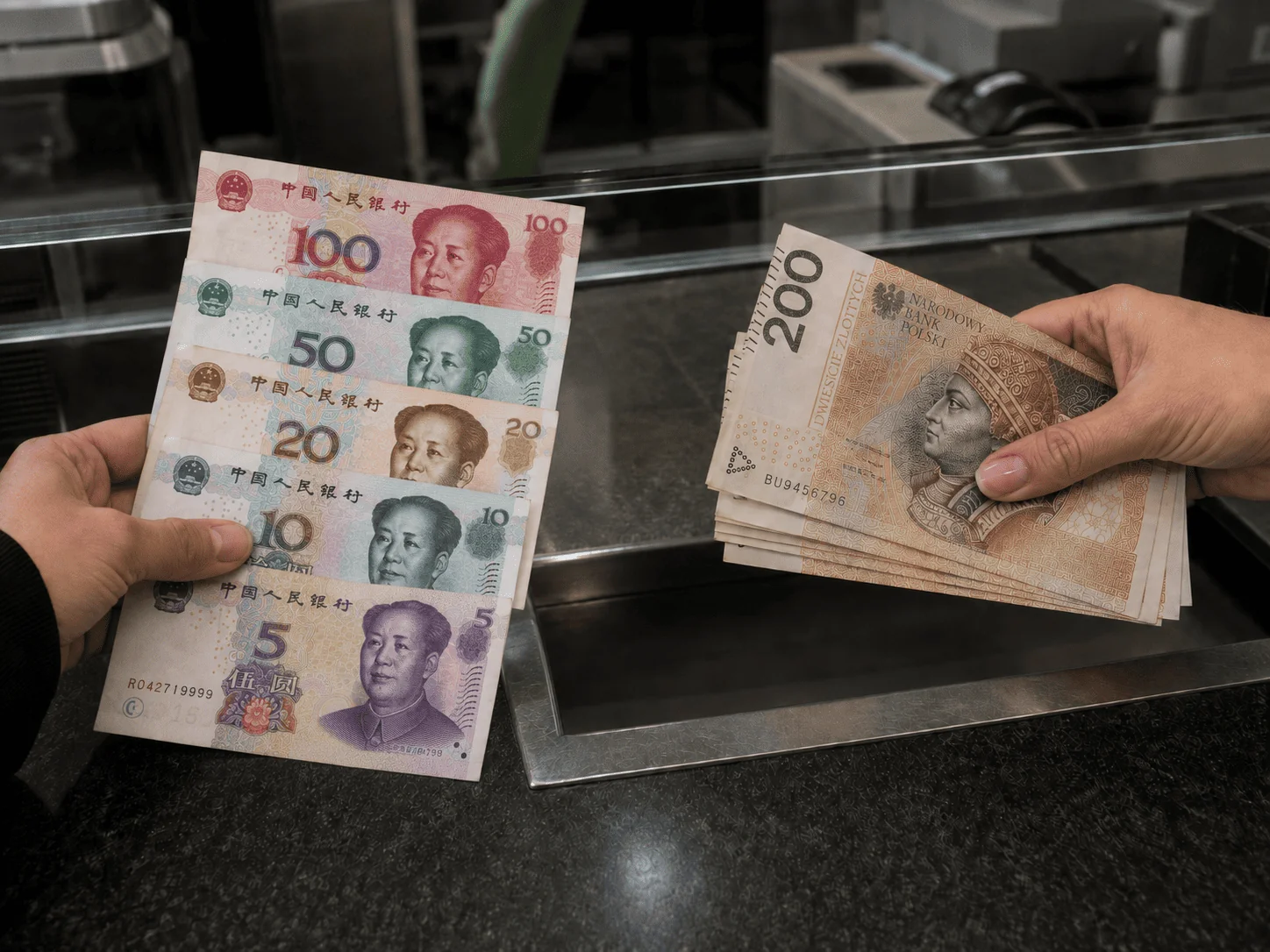
The Chinese yuan (CNY) is the currency of the People’s Republic of China – formally the renminbi, RMB for short. At the Argentarii exchange office in Warsaw you can settle your yuan in cash: we buy back the notes left over after your trip, and before you travel we will help you put the amount together.
The office is at ul. Grzybowska 61 in the Platinum Towers complex, in the Wola district. The yuan buy and sell rates are shown on the board and on our page with live exchange rates, and there is no commission – only the rate counts. The rate is the same regardless of the amount. For a larger sum, call a day ahead and we will have the cash ready at an agreed time.
CNY/PLN rate
1 CNY = 0.5450 zł

Buying rate from this page. It is more favourable than the rate on the board in our branch, ask the cashier for it.
The currency you want to receive is temporarily out of stock. Rate reservation is unavailable. We buy this currency as usual, swap the direction to calculate.
A reservation holds the rate for 60 minutes. The rate from this page does not cover small denominations, damaged notes, old series or coins.
Today’s Chinese yuan rate (CNY/PLN)
The yuan rate moves during the day along with international quotations. The rate valid at any given moment is published on agkantor.pl. It is more favourable than the board rate, so ask for it at the counter on Grzybowska.
Our reference point is the NBP mid rate. The yuan is quoted daily in NBP table A – unlike the UAE dirham or the Albanian lek, published once a week in table B. On 7 August 2026 the NBP valued the yuan at PLN 0.5530 (table no. 152/A/NBP/2026).
An exchange office rate always differs from the NBP mid rate – that is the normal gap between a reference rate and the price of physical cash. So check the rate on the day you exchange, not the last central bank release.
How much is 100 CNY in złoty
At the NBP mid rate, 1 CNY = 0.5732 zł (table 188/A/NBP/2026 of 28 September 2026), which means 1 zł = 1.7446 CNY.
At the Argentarii exchange office at Grzybowska 61 we buy CNY today at 0.5450 zł and sell at 0.5750 zł (website rate, updated 28.08.2026, 08:44).
| Amount | At NBP rate | You sell to us: you receive | You buy from us: you pay |
|---|---|---|---|
| 10 CNY | 5.73 zł | 5.45 zł | 5.75 zł |
| 50 CNY | 28.66 zł | 27.25 zł | 28.75 zł |
| 100 CNY | 57.32 zł | 54.50 zł | 57.50 zł |
| 500 CNY | 286.60 zł | 272.50 zł | 287.50 zł |
| 1,000 CNY | 573.20 zł | 545.00 zł | 575.00 zł |
| Amount in zł | At NBP rate | You buy from us: you receive |
|---|---|---|
| 100 zł | 174.46 CNY | 173.91 CNY |
| 500 zł | 872.30 CNY | 869.57 CNY |
| 1,000 zł | 1,744.59 CNY | 1,739.13 CNY |
Amounts are indicative and the rate changes during the day; at the counter the rate at the moment of the transaction applies. The website rate is more favourable than the rate on the board in our branch, ask the cashier for it. It does not cover small denominations, damaged notes, old series or coins.
For the exact amount at our current buying and selling rate, use the calculator above.
How much is 1 yuan and how much is 100 yuan in zloty
Against the zloty the yuan is a small unit: one yuan costs roughly half a zloty, usually between PLN 0.50 and 0.60. As a rough guide, 100 yuan is about PLN 50–60 and 1000 yuan is around PLN 500–600. Dividing Chinese prices by two gives you a workable estimate in zloty.
That is an approximation, not a rate. For the exact value of 100, 500 or 1000 CNY use the calculator above. It converts at the rate currently in force at the office.
Yuan or renminbi – what the Chinese currency is really called
Both names are correct and describe the same money at different levels. Renminbi (RMB, literally “the people’s currency”) is the name of the Chinese monetary system, while the yuan (元) is the unit amounts are quoted in. The relationship mirrors pound sterling and the pound: prices are expressed in yuan, but the currency is the renminbi.
The ISO code is CNY. In everyday speech the Chinese also use the word kuài. One yuan divides into 10 jiao and 100 fen, though the smallest denominations have effectively left circulation.
CNY and CNH – why the yuan has two quoted rates
Financial services show CNH alongside CNY. It is the same currency, but settled outside mainland China – chiefly in Hong Kong and Singapore. The CNY rate is formed on the domestic market under close central bank supervision, while CNH is priced by the international market without those constraints.
The gap between the two quotes is usually small, but it can widen in periods of stress – and then two calculators will show two different figures for the same amount. At an exchange office you are trading physical banknotes, so a cash rate applies, not the offshore quote.
What drives the yuan against the zloty
The yuan is not a fully floating currency. Every morning the People’s Bank of China announces a central parity rate against the dollar and allows the market to move no more than 2 percent away from it during the session. The yuan rate is therefore managed: the central bank smooths swings that nobody would dampen in the euro or the pound.
For the CNY/PLN pair this creates a simple relationship. The yuan follows the dollar, while the zloty follows the euro, so when the dollar strengthens against the zloty, the yuan usually moves the same way. Chinese export data, tariff decisions and capital flows sit on top of that.
Buying and selling yuan in Warsaw
We buy and sell yuan for cash – the CNY buy and sell rates are published on the board next to the other currencies. Coming back from China with notes you will not use on your next trip? You can sell them to us on the spot, with no ordering and no prepayment.
The yuan is one of the currencies Polish exchange offices rarely keep on hand, because China restricts how much of its cash may leave the country. If you need yuan before you travel, call +48 791 901 979 and confirm that the denominations are available. We accept and issue banknotes only; Chinese coins are not bought.
Which Chinese banknotes we accept
The fifth series of the renminbi is in circulation, with denominations of 1, 5, 10, 20, 50 and 100 yuan. Every note carries a portrait of Mao Zedong on the front, and the denominations are told apart by colour. The 100 is red, the 50 green, the 20 brown.
The series has several editions: the 100 yuan note in its 2015 version, the 1, 10, 20 and 50 yuan notes issued in 2019, and the 5 yuan refreshed in 2020. All of them circulate side by side and all of them are accepted. We do not buy fourth series notes, withdrawn from circulation on 30 April 2018, or Chinese coins.
How much yuan you can bring in and take out of China
China caps the movement of cash across its border. A traveller may carry up to 20,000 yuan in either direction without declaring it, and for foreign currencies the threshold is the equivalent of USD 5,000. Above those limits a customs declaration and documents showing the source of funds are required.
This is one reason the yuan so rarely reaches Polish exchange offices in quantity. It is also an argument for settling leftover cash after you return rather than keeping it in a drawer until the next trip – the yuan rate can move by several percent in the meantime.
Cash, card or phone – how people pay in China
China runs on mobile payments: day to day people pay by QR code in Alipay and WeChat Pay, and both apps now support foreign cards. Visa and Mastercard are accepted in hotels and large retail chains, but not always in smaller venues, markets and taxis.
Cash therefore remains a safety net. Since 1 February 2026 China has had regulations on cash acceptance that explicitly forbid merchants to refuse yuan in cash and require them to keep enough coins to give change. A sensible plan is a modest amount in banknotes with the rest settled through an app.
How exchanging yuan works at our office
The exchange takes a few minutes. You come to the counter, hand over the banknotes, and the cashier checks them in a detector and counts them. You see the rate on the board before the transaction. We add no commission and no counting fee, and you are paid in cash immediately.
Identification is only required for transactions worth EUR 15,000 or more, under AML rules. If you want certainty about the rate, reserve it by phone or through the contact form: we hold the website rate free of charge for 60 minutes, whatever the amount.
Argentarii exchange office – Grzybowska 61, Warsaw
The office is at ul. Grzybowska 61 in Platinum Towers, in Wola, a few minutes from Rondo Daszyńskiego. Besides the yuan you can exchange more than twenty currencies here – from the euro and the dollar to the Turkish lira, the Romanian leu, the Thai baht and the Ukrainian hryvnia. The full list is on our currency exchange page.
We serve customers in Polish, English, Ukrainian and Russian. We do not accept payment cards. There is parking on site, and the entrance is wheelchair accessible.
At the same counter we also run gold buying in Warsaw and euro exchange. Opening hours and directions are on the contact page; if you are planning a larger exchange, let us know in advance. We will prepare the cash and confirm the rate.
Frequently asked questions about exchanging yuan
What is today’s Chinese yuan rate at your exchange office?
We publish the current yuan rate on agkantor.pl and update it throughout the working day. When you exchange in person at Grzybowska 61, ask the cashier for this rate: it is more favourable than the board. The rate is the same regardless of the amount.
How much is 1 yuan and how much is 100 yuan in zloty?
One yuan usually costs PLN 0.50–0.60, so 100 yuan is roughly PLN 50–60 and 1000 yuan about PLN 500–600. That is an approximation – for the exact amount use the currency calculator on the home page, which converts at the rate in force at the time.
Yuan or renminbi – which is the correct name?
Renminbi is the name of the Chinese currency and the yuan is the unit amounts are quoted in, much like pound sterling and the pound. The ISO code is CNY. In English both “Chinese yuan” and “renminbi” are used and both are correct.
What currency is used in China?
Mainland China uses the Chinese yuan (CNY), that is the renminbi. Hong Kong and Macau have their own currencies – the Hong Kong dollar and the pataca – so yuan will not get you far there. Taiwan uses the New Taiwan dollar.
Do you buy Chinese coins and older series banknotes?
We buy fifth series renminbi banknotes only – the 1, 5, 10, 20, 50 and 100 yuan denominations in the editions currently circulating. Coins are not accepted, and neither are fourth series notes, withdrawn from circulation on 30 April 2018.
How much yuan can you take out of China?
Without a customs declaration a traveller may carry up to 20,000 yuan in cash in either direction. For foreign currencies the limit is the equivalent of USD 5,000. Above those amounts you must declare the money at customs and present documents.