


Japanese yen exchange rate (JPY) – changing yen to złoty in Warsaw
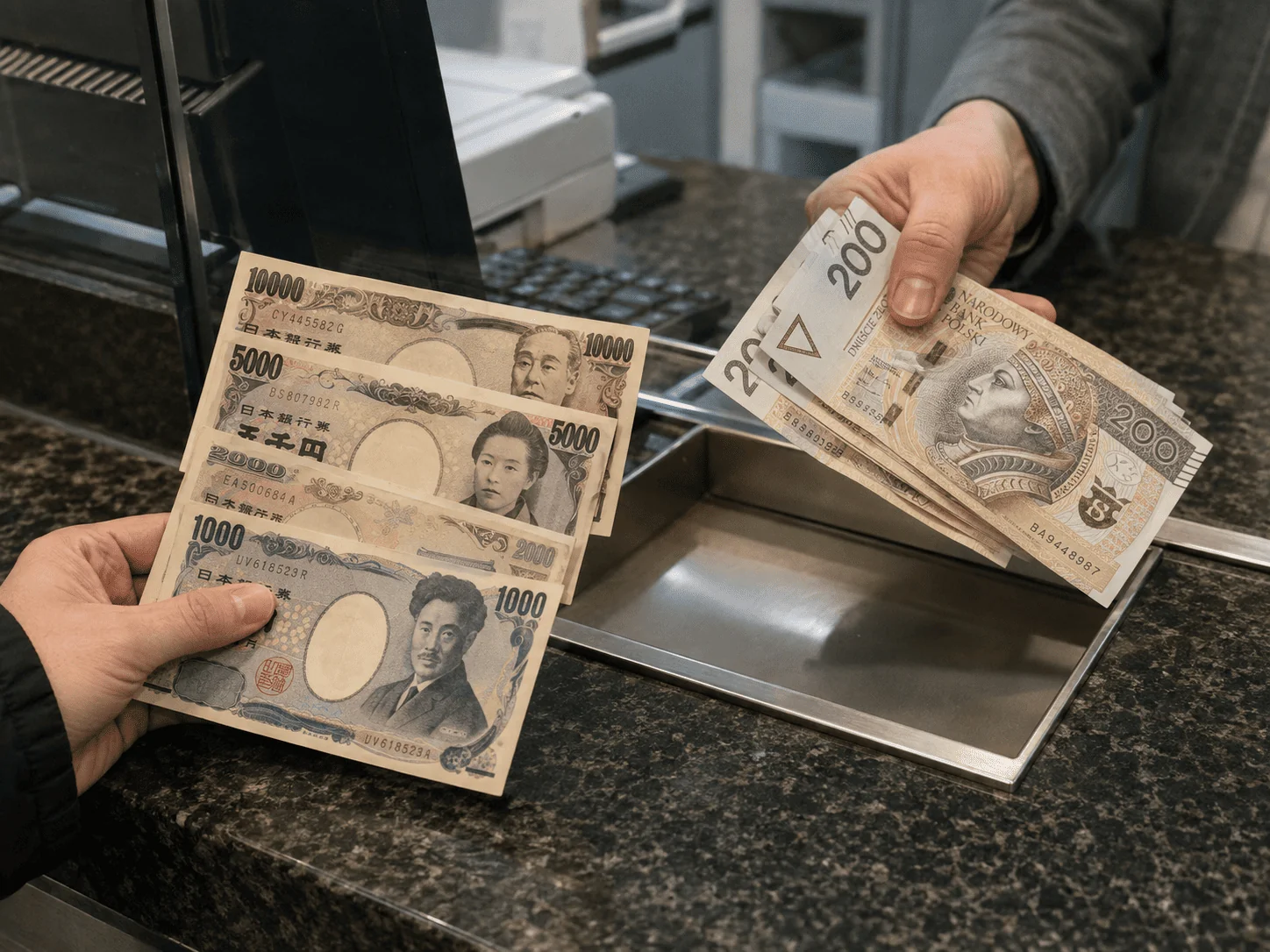
We exchange Japanese yen (JPY) for złoty and złoty for yen at the Argentarii exchange office at Grzybowska 61 in the Wola district of Warsaw. You see the rate on the board before you reach the counter, and it is the same for five thousand yen and for five hundred thousand.
The yen is a currency Polish exchange offices tend to order rather than keep in the drawer. Call us a day ahead on +48 791 901 979 if you need a larger amount or particular denominations and we will have the cash ready at an agreed time. The exchange rates on our home page update automatically several times a day.
JPY/PLN rate
1 JPY = 0.0240 zł

Buying rate from this page. It is more favourable than the rate on the board in our branch, ask the cashier for it.
The currency you want to receive is temporarily out of stock. Rate reservation is unavailable. We buy this currency as usual, swap the direction to calculate.
A reservation holds the rate for 60 minutes. The rate from this page does not cover small denominations, damaged notes, old series or coins.
Current yen to PLN exchange rate (JPY/PLN)
The mid rate published by the National Bank of Poland on 7 August 2026 (table 152/A/NBP/2026) is 0.023565 złoty per yen. That is under two and a half grosz, which is why Japanese price tags look intimidating at first glance and turn out not to be. The yen sits in table A, so the NBP publishes it every business day, just like the euro or the dollar.
One detail causes confusion when comparing offers. The NBP quotes the rate per single yen, while many financial services and exchange boards show it per 100 yen, because a figure with four decimal places simply reads better. A rate of 2.3565 per hundred yen and 0.023565 per one are exactly the same value. Before you conclude that somewhere is a hundred times cheaper, check how many yen the number refers to.
An exchange office rate always differs from the NBP mid rate because it includes a buy and sell margin. Both sides are on our board before the transaction.
How much is 1000 yen and how many yen for 100 złoty
The figures below use the NBP mid rate of 7 August 2026 so that you can verify them at the source. The exchange office rate differs by the margin.
At the NBP mid rate, 1 JPY = 0.0245 zł (table 188/A/NBP/2026 of 28 September 2026), which means 1 zł = 40.7780 JPY.
At the Argentarii exchange office at Grzybowska 61 we buy JPY today at 0.0240 zł; selling this currency is temporarily unavailable (updated 08.09.2026, 07:38).
| Amount | At NBP rate | You sell to us: you receive | You buy from us: you pay |
|---|---|---|---|
| 100 JPY | 2.45 zł | 2.40 zł | n/a |
| 500 JPY | 12.26 zł | 12.00 zł | n/a |
| 1,000 JPY | 24.52 zł | 24.00 zł | n/a |
| 5,000 JPY | 122.62 zł | 120.00 zł | n/a |
| 10,000 JPY | 245.23 zł | 240.00 zł | n/a |
| Amount in zł | At NBP rate | You buy from us: you receive |
|---|---|---|
| 100 zł | 4,077.80 JPY | n/a |
| 500 zł | 20,389.02 JPY | n/a |
| 1,000 zł | 40,778.05 JPY | n/a |
Amounts are indicative and the rate changes during the day; at the counter the rate at the moment of the transaction applies. The website rate is more favourable than the rate on the board in our branch, ask the cashier for it. It does not cover small denominations, damaged notes, old series or coins.
The other way round: 100 zł buys roughly 4240 yen, 500 zł about 21,200 yen and 1000 zł about 42,400 yen. One złoty is therefore worth roughly 42 yen.
The simplest mental shortcut while travelling: drop two zeros from the price and multiply by 2.36. A 1200 yen dish on a menu is 12 times 2.36, so about 28 zł. Divide by 42 to go from złoty back to yen. You can work out the exact amount in the calculator above, but those two tricks are enough to know at a convenience store till whether you are paying five złoty or fifty.
How much is one million yen in złoty
One million yen is about 23,565 zł at the NBP mid rate of 7 August 2026. Half a million yen comes to roughly 11,780 zł and ten million to about 235,000 zł. This is the single most searched yen conversion in Poland, because the round million turns up wherever people meet Japanese figures: prize money in manga and anime, descriptions of Japanese salaries, prices of cars bought at auction.
A million yen also has a practical meaning in Japan. It is one hundred 10,000 yen notes, a single standard bank bundle held by a paper band, a stack roughly a centimetre thick. The same figure is the customs threshold: above one million yen cash has to be declared both on entering Japan and on leaving it. The million is not an arbitrary round number but the unit in which Japanese people actually think about larger sums.
Japanese yen and Chinese yuan are two different currencies
Yen and yuan are mixed up often enough to be worth a paragraph. China uses the yuan (CNY, renminbi), Japan the yen (JPY), and the confusion comes from the fact that Japanese 円, Chinese 元 and Korean 원 all descend from the same Chinese character 圓, meaning something round. Hence the similar sound of three separate currencies.
The difference in value is large enough to matter. At the NBP rate of 7 August 2026 one yuan is worth more than twenty times one yen. If you are looking for the Chinese currency, go to Chinese yuan (CNY). If Korean, we have a separate page on the Korean won. We exchange all three at the same counter.
What currency is used in Japan
The currency of Japan is the yen, ISO 4217 code JPY, symbol ¥, written 円 in Japanese. Banknotes are issued by the Bank of Japan; coins are struck by the Japan Mint on behalf of the Ministry of Finance.
Formally the yen used to be divided into 100 sen, and a sen into 10 rin. Units smaller than one yen lost legal tender status at the end of 31 December 1953 under the act on the disposition of small currency. The sen survives only as a unit of account in exchange rate quotations and interest calculations. In practice the yen is an indivisible currency today, which makes paying cash very simple: you never get change in fractions, because none exist.
The romanisation is “yen” rather than “en”, and the Bank of Japan explains that this spelling was already fixed on the first government notes of 1872, adding that the exact reason is not known. The origin of the name itself is equally open: Japan’s Ministry of Finance states plainly that the records from the 1871 currency reform have not survived, so the round-coin explanation is one of several hypotheses rather than a fact.
What moves the yen against the złoty
JPY/PLN is not quoted directly on the international market. The rate you see in an exchange office comes from crossing two pairs through the dollar, which is why the yen moves against the złoty even when nothing happens in Tokyo or Warsaw and only the dollar to złoty rate changes.
The main factor on the Japanese side is the interest rate gap. For years the Bank of Japan held its policy rate below zero while the Federal Reserve and other central banks raised theirs. Such a gap fuels the carry trade: investors borrow cheaply in yen and place the money in higher-yielding currencies, which steadily weakens the yen. The Bank of Japan ended negative rates on 19 March 2024 and has raised them several times since, to around 1 percent in June 2026. That is the highest level since 1995, and the gap against US rates is still wide.
The carry trade also works in reverse, and it can do so abruptly. After the rate rise of 31 July 2024 investors began closing yen-funded positions on a large scale. On 5 August 2024 the Nikkei 225 fell 12.4 percent in a single session, its steepest drop since October 1987, and the yen gained more than ten percent in three weeks. Anyone changing cash at that moment saw the difference on the board from one day to the next.
The third factor is the trade balance and commodity prices. Japan imports almost all of its energy, so rising oil weakens the yen and falling oil supports it. The fourth is the yen’s safe-haven status: during global panics capital has historically returned to the yen, although that mechanism has worked less reliably in recent years.
A record weak yen and the interventions of 2024–2026
The past four years have brought the yen a run of record lows and the largest currency interventions in Japanese history. The Ministry of Finance publishes the amounts, so these are official figures rather than market estimates.
In September 2022 Japan bought yen on the market for the first time since 1998, and in October of the same year it spent a further 6.3 trillion yen. In July 2024 the dollar cost 161.95 yen, the most since 1986. Defending the currency cost Tokyo 15.3 trillion yen over 2024, including 9.8 trillion at the turn of April and May and 5.5 trillion in July.
2026 brought larger numbers still. Between 28 April and 27 May 2026 the ministry spent 11.7 trillion yen within a single reporting period, the largest figure in the monthly series. It did not stop the trend: on 30 June 2026 the dollar reached 162.33 yen, breaking the 1986 record, and in the second half of July the rate passed 163.
The turn came at the end of July and beginning of August 2026. On 3 August Japan’s Ministry of Finance and the US Treasury Secretary confirmed a joint intervention by both countries, the first since 2011. The yen strengthened 1.4 percent that day to around 155 per dollar, its strongest level in nearly three months. The NBP mid rate of 7 August 2026 used for the conversions on this page already comes from the period after that intervention.
The practical conclusion for someone travelling to Japan is that the yen moves in a wider band than most European currencies, and the difference between last month’s rate and today’s can run to several percent. That is not a reason to wait for a perfect moment, only to check the rate on the day you exchange rather than rely on a figure remembered from last year.
Buying and selling yen in Warsaw
We both buy and sell Japanese yen. If you are coming back from Japan with cash you did not spend, we will change it into złoty at the counter. If you are still preparing for the trip, we will get yen ready for you; for a larger amount or less common denominations call a day ahead and we will have the cash at an agreed time.
The rate is the same whatever the amount. There are no thresholds above which a better rate begins, so you do not need to inflate the transaction to avoid losing on the conversion. Besides the yen we exchange 24 currencies, including euro and dollars, so a trip with a stopover in Europe or Asia can be handled in one place.
Which Japanese banknotes we accept
Four denominations circulate: 1000, 2000, 5000 and 10,000 yen. On 3 July 2024 the Bank of Japan introduced a new series of three of them. The 10,000 yen note shows Shibusawa Eiichi and the Marunouchi side of Tokyo Station, the 5000 yen note Tsuda Umeko and wisteria flowers, the 1000 yen note Kitasato Shibasaburō and Hokusai’s Great Wave off Kanagawa. The new series carries a hologram in which the portrait rotates in three dimensions; according to Japan’s Ministry of Finance this is the first such use on banknotes anywhere.
The previous 2004 series, with Fukuzawa Yukichi on the 10,000, Higuchi Ichiyō on the 5000 and Noguchi Hideyo on the 1000 yen note, remains full legal tender and still circulates in Japan alongside the new one. We accept both series. This differs from the Swiss franc or the Czech koruna, where older series have been withdrawn and an exchange office cannot buy them.
The Bank of Japan states that of the 56 banknote types issued since 1885, 25 are still valid. Invalidation has happened only three times: in 1927 after the Kantō earthquake, during the post-war currency conversion of 1946 and with the abolition of small currency in 1953. In practice a note issued after 1946 is still valid in Japan, although for obvious reasons we do not buy older vintages – those are exchanged at the Bank of Japan, not at a counter in Warsaw.
The 2000 yen note is a case of its own. Issued in 2000 with the Shureimon gate of Okinawa, it is formally in circulation and remains valid, but the Bank of Japan no longer orders it printed – the issuance plan for fiscal 2025 covers only the 1000, 5000 and 10,000 yen notes. It is rarely seen in Japan outside Okinawa, so if you have one, treat it as a souvenir of the trip.
We do not accept coins – the cost of processing them exceeds their value, so small change is best spent before you leave. In Japan this matters more than elsewhere, because coins run all the way up to 500 yen, about 12 zł. Towards the end of a trip it is worth putting them into a vending machine or topping up a transport card rather than carrying them home.
How much cash you can bring into and out of Japan
Japan Customs requires a declaration if you carry means of payment worth more than one million yen, roughly 23,500 zł at the current rate. The rule applies in both directions, on entry and on departure, and covers yen cash, foreign currency, cheques, promissory notes and securities counted together.
A separate threshold applies to precious metal: gold of purity above 90 percent has to be declared if its total weight exceeds one kilogram. The declaration is filed on a customs form in the inspection area at the airport or electronically. Crossing the threshold means neither a ban nor a tax; it is a reporting obligation.
The departure charge went up on 1 July 2026 as well. The international tourist tax is now 3000 yen per person instead of the previous thousand, and everyone leaving Japan pays it, Japanese citizens included. It is included in the air ticket price, so there is nothing to settle separately at check-in.
Cash or card – how people pay in Japan
Japan’s reputation as a cash country is partly out of date. According to the Ministry of Economy, Trade and Industry, cashless payments reached 58 percent of consumption in 2025 on the domestic indicator, or 46.3 percent on the internationally comparable one. The ministry publishes both figures and they differ in method. The government target of 40 percent by 2025 was met, and the new milestone is 65 percent by 2030.
In practice this means that in Tokyo, Osaka and Kyoto a card works almost everywhere, while smaller restaurants, temples, markets, some ryokan and ticket machines still want cash. A sensible plan for a two-week trip is to change enough for the first days and daily small spending, and leave the rest to the card.
If you plan to use ATMs, the most dependable are Japan Post Bank machines in post offices and FamilyMart stores and Seven Bank machines in 7-Eleven, of which there are more than 28,000. Japan Post Bank publishes a fee of 220 yen per transaction and a limit of 50,000 yen per withdrawal. Seven Bank allows up to 100,000 yen at a time but publishes no single fee table, stating only that the charge depends on the card scheme, so the specific figures circulating in travel guides do not come from an official tariff. Lawson Bank ATMs handle foreign cards only at some locations and only for selected schemes.
On top of that comes your card issuer’s commission and the DCC trap, the offer to convert the withdrawal into złoty at the machine’s own rate. Always choose to withdraw in yen. Across several withdrawals in one trip the fees alone can exceed the exchange rate difference that usually gets all the attention.
Suica and Pasmo transport cards are worth knowing about. Their sale was suspended from 2023 because of a semiconductor shortage, but registered cards returned to sale on 1 September 2024 and unregistered ones on 1 March 2025. For visitors there is a separate Welcome Suica, valid 28 days, with no deposit and no refund of the unused balance. Cards are topped up with cash, so yen in your pocket are useful even when you travel cashless.
And one thing that saves awkwardness: tipping is not done in Japan. The Japan National Tourism Organization states plainly that tipping is not customary in bars, cafés, restaurants, taxis or hotels. Money left on a table is usually returned, treated as something you forgot.
How many yen to take to Japan
Japan is breaking visitor records. 36.9 million foreign travellers came in 2024 and 42.7 million in 2025, up 15.8 percent and above 42 million for the first time. Heavier traffic and a weak yen mean a trip that counted as very expensive a few years ago now works out more reasonably in złoty.
For a rough sense of scale: onigiri at a convenience store usually costs 150–200 yen, so 4–5 zł; coffee in a café about 500 yen, just under 12 zł; a bowl of ramen 900–1200 yen, 21–28 zł; a single metro ride in Tokyo 180–210 yen, under 5 zł. Prices vary between cities and districts, so treat these as a reference point rather than a price list.
When planning shopping, keep in mind the change taking effect on 1 November 2026. Tax-free shopping for visitors moves to a refund-at-departure system: you pay the tax-inclusive price in the shop and receive the refund once customs confirms the goods are leaving the country. The minimum is 5000 yen per shop per day, and the previous 500,000 yen cap on consumables disappears.
We exchange other Asian currencies too, so if the plan includes a stopover or a longer route around the region, we can prepare Thai baht or Vietnamese dong during the same visit.
How the exchange works at our counter
The exchange takes a few minutes. You come to the counter, say how much you want to change and in which direction, and we convert it at the board rate, or at the more favourable rate from this page if you ask for it. You see the rate before the transaction, not after. For larger sums anti-money-laundering rules apply and we will ask for identification.
Notes go through a counting machine with an authenticity test. Japanese banknotes are convenient in this respect: they carry tactile identification marks, a watermark and a hologram, and the 2024 series added a serial number extended to ten characters.
Argentarii exchange office – Grzybowska 61, Warsaw
The office is at Grzybowska 61 in the Platinum Towers complex in Wola, a few minutes’ walk from Rondo Daszyńskiego. Phone: +48 791 901 979. The address and opening hours are on our contact page.
We serve customers in Polish, English, Ukrainian and Russian. We do not accept payment cards. There is parking on site, and the entrance is wheelchair accessible.
Besides currency exchange we run gold buying in Warsaw – 585, 750 and 999 fineness, scrap, bars and coins. If you are coming back from Japan with jewellery, we will value it on the spot.
Frequently asked questions about exchanging yen
How much is 1000 yen in złoty?
At the NBP mid rate of 7 August 2026 (table 152/A/NBP/2026) 1000 yen is about 23.57 zł. At the same rate 5000 yen comes to roughly 118 zł and 10,000 yen to about 236 zł. The exchange office rate differs from the NBP mid rate and we show it on the board before the transaction.
How much is 1 million yen in złoty?
One million yen is about 23,565 zł at the NBP mid rate of 7 August 2026. Half a million comes to roughly 11,780 zł and ten million to about 235,000 zł. A million yen is also one hundred 10,000 yen notes, a single standard bank bundle, and the threshold above which cash must be declared to Japan Customs.
How much is 30,000 yen in złoty?
30,000 yen is about 707 zł at the NBP mid rate of 7 August 2026. For comparison, 40,000 yen comes to roughly 943 zł and 50,000 yen to about 1178 zł. A quick mental check: drop two zeros and multiply by 2.36.
How many yen will I get for 100 złoty?
At the NBP mid rate of 7 August 2026, 100 zł buys about 4240 yen and 1000 zł about 42,400 yen. One złoty therefore corresponds to roughly 42 yen. You can calculate the exact amount at the exchange office rate in the calculator on our home page.
Do you buy Japanese yen?
Yes, we buy and sell Japanese yen at Grzybowska 61 in Warsaw. We buy banknotes only; we do not take coins. For a larger amount or less common denominations call a day ahead on +48 791 901 979 and we will have the cash ready at an agreed time.
Which yen banknotes do you accept?
We accept the 1000, 2000, 5000 and 10,000 yen denominations, both the new series introduced on 3 July 2024 and the previous one from 2004 – both are full legal tender in Japan. Notes must be whole and undamaged. We do not buy coins in any currency.
How much cash can you take out of Japan?
Amounts above one million yen, about 23,500 zł, must be declared to Japan Customs, both on entry and on departure. The limit counts all means of payment together rather than yen and foreign currency separately. Below that threshold there are no formalities.