


Korean won exchange rate (KRW) – changing won into złoty in Warsaw
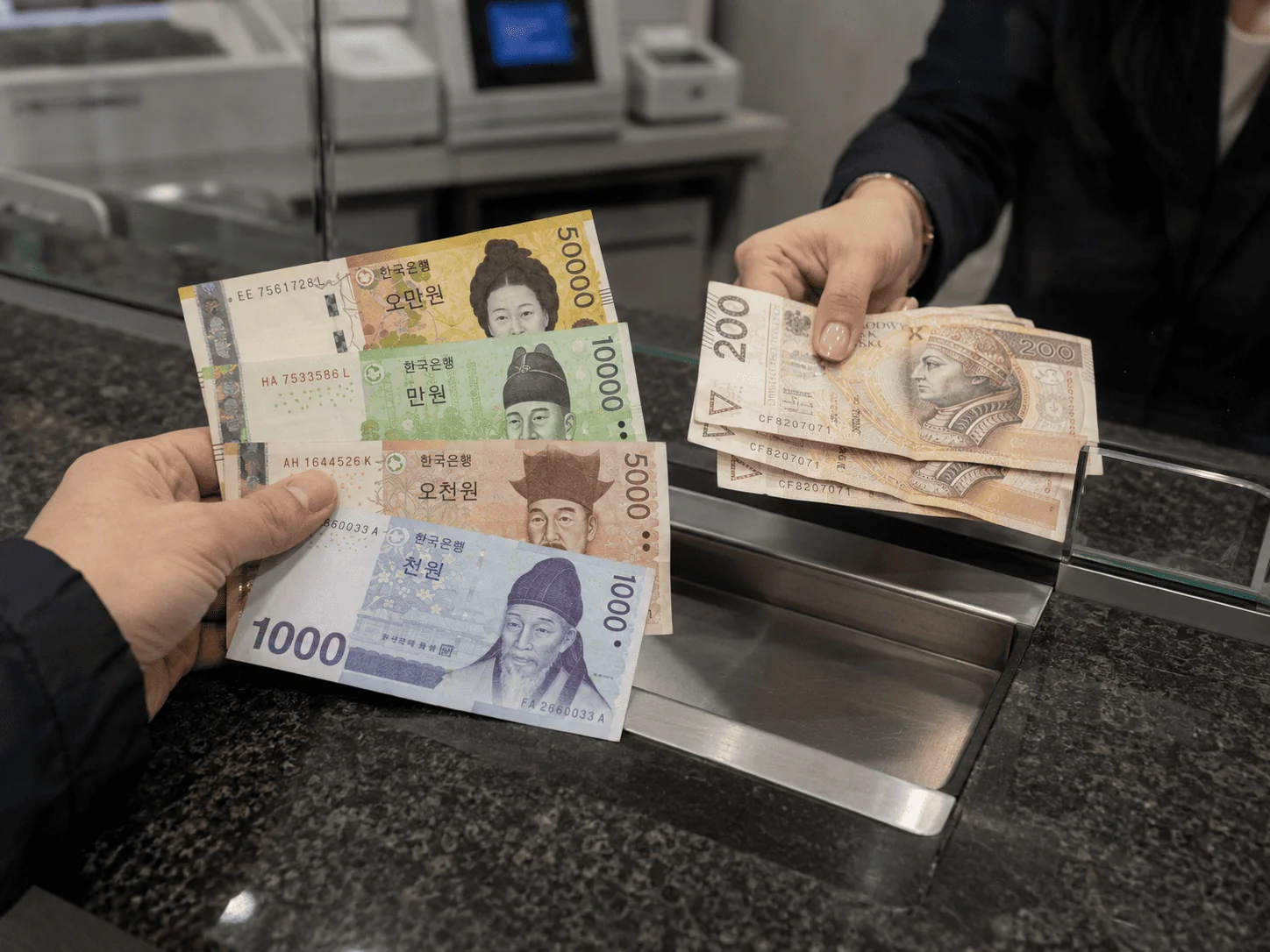
We buy and sell South Korean won (KRW) for Polish złoty at the Argentarii kantor at Grzybowska 61 in Wola, Warsaw. The rate is on the board before you reach the counter, and it is the same whether you change one hundred thousand won or five million.
The won is not a currency Polish exchange offices keep in the drawer every day. Call a day ahead on +48 791 901 979 and we will have the cash ready at an agreed hour. The same applies the other way round, when you come back from Seoul with a large amount of won to change.
KRW/PLN rate
1 KRW = 0.0026 zł

Buying rate from this page. It is more favourable than the rate on the board in our branch, ask the cashier for it.
The currency you want to receive is temporarily out of stock. Rate reservation is unavailable. We buy this currency as usual, swap the direction to calculate.
A reservation holds the rate for 60 minutes. The rate from this page does not cover small denominations, damaged notes, old series or coins.
Today’s Korean won exchange rate (KRW/PLN)
The current buying and selling rate for the won is in the rate table on our home page, refreshed automatically every half hour. The reference point is the NBP mid-rate: on 7 August 2026 (table 152/A/NBP/2026) it stood at 0.002633 zł per won, which is 2.63 zł per 1,000 won.
The National Bank of Poland quotes the won in table A, alongside the dollar, the euro and the yen, so a KRW rate is published every business day. Table B still carries an archived entry from 2007, so if you check the won on a site that aggregates NBP data, make sure you are looking at table A.
How much is 1,000 won and how many won do you get for 100 złoty
At the NBP mid-rate of 0.002633 zł (7 August 2026, table 152/A/NBP/2026) the conversion works out like this:
At the NBP mid rate, 1 KRW = 0.002829 zł (table 188/A/NBP/2026 of 28 September 2026), which means 1 zł = 353.48 KRW.
At the Argentarii exchange office at Grzybowska 61 we buy KRW today at 0.002600 zł; selling this currency is temporarily unavailable (updated 24.09.2026, 08:58).
| Amount | At NBP rate | You sell to us: you receive | You buy from us: you pay |
|---|---|---|---|
| 1,000 KRW | 2.83 zł | 2.60 zł | n/a |
| 5,000 KRW | 14.15 zł | 13.00 zł | n/a |
| 10,000 KRW | 28.29 zł | 26.00 zł | n/a |
| 50,000 KRW | 141.45 zł | 130.00 zł | n/a |
| 100,000 KRW | 282.90 zł | 260.00 zł | n/a |
| Amount in zł | At NBP rate | You buy from us: you receive |
|---|---|---|
| 100 zł | 35,348 KRW | n/a |
| 500 zł | 176,741 KRW | n/a |
| 1,000 zł | 353,482 KRW | n/a |
Amounts are indicative and the rate changes during the day; at the counter the rate at the moment of the transaction applies. The website rate is more favourable than the rate on the board in our branch, ask the cashier for it. It does not cover small denominations, damaged notes, old series or coins.
won
The quickest mental shortcut is to drop three zeros and multiply by 2.6. A 50,000 won note becomes 50 × 2.6 = 130 zł, a 10,000 won note becomes 10 × 2.6 = 26 zł. Going the other way, one złoty is roughly 380 won.
A single won is worth about a quarter of a grosz, which is why Korean prices look enormous at first: a 5,000 won coffee is 13 zł, a 12,000 won lunch is 32 zł and a 120,000 won hotel night is 316 zł. For the exact amount at our own rate, use the currency calculator on the home page.
South Korean won and North Korean won are two different currencies
In our kantor and in NBP tables, “Korean won” always means the South Korean won, currency code KRW. That is the currency of the Republic of Korea and that is what we buy and sell.
North Korea has its own money under the same name, code KPW. It is issued by the central bank in Pyongyang, it is not traded on international markets and it does not appear in NBP tables. No exchange office in Poland buys or sells it.
The scale of the difference is easiest to show with numbers. In November 2009 North Korea carried out a redenomination at one hundred old won for one new won, after which the currency lost more than 90 percent of its value against the dollar within days. The black-market rate has diverged from the official one by an order of magnitude for years, reaching roughly 8,900 won per dollar in April 2025. KPW notes offered in Europe are collectors’ items rather than money you can spend.
What currency is used in South Korea
The currency of South Korea is the won, ISO code KRW, symbol ₩, issued by the Bank of Korea (한국은행). One won formally divides into one hundred jeon, but the jeon exists in neither coins nor banknotes and shows up only in exchange rate notation. It is one of the few currencies whose subunit lives on paper alone.
The won in its present form was introduced on 10 June 1962, replacing the hwan at one won for ten hwan. Earlier hwan notes and the first won of 1950 to 1953 are no longer legal tender, and even the Bank of Korea does not exchange them.
How much is the 45.6 billion won from “Squid Game”
The prize from the series “Squid Game”, 45.6 billion won, is the single most searched amount in this currency. At the NBP mid-rate of 7 August 2026 it comes to about 120 million złoty. The figure is not arbitrary: 456 players take part and 100 million won goes into the pot for every player eliminated, so 456 × 100 million = 45.6 billion.
Other amounts that keep coming up in Korean drama and in search convert like this:
- 100 million won is about 263,000 zł
- 300 million won is about 790,000 zł
- 1 billion won is about 2.63 million zł
- 10 billion won is about 26.3 million zł
The same prize looked different in dollars depending on when you counted it: roughly 38.5 million at the 2021 rate and around 31.5 million at the rate of December 2024. The won amount never changed. The rate did. That is the plainest illustration of why timing matters when you exchange money.
What moves the won against the złoty
The won has floated freely since 24 December 1997, when Korea moved to a floating rate during the Asian financial crisis under its agreement with the IMF. The market is supervised jointly by the Bank of Korea and the Ministry of Economy and Finance.
There is no interbank KRW/PLN pair. The won to złoty rate is a cross rate through the dollar, derived from USD/KRW and USD/PLN. In practice the won reacts here to everything that happens to the dollar, so it is worth checking the dollar to złoty rate alongside it.
The last two years have been hard on the won. After martial law was declared on 3 December 2024 the currency weakened sharply, and on 31 December 2024 the rate reached 1,473.7 won per dollar. In 2025 the trade war and foreign outflows from the Korean stock market pushed it further: on 9 April 2025 the won was at its weakest since 2009, at 1,484.1 per dollar, and in December 2025 it broke through 1,480 again, recovering only after a joint verbal intervention by the ministry and the central bank.
For a traveller the conclusion is simple. The gap between a good moment and a poor one can be worth a double-digit percentage of the whole trip budget, so if your flight to Seoul is booked well in advance, watching the rate for a few weeks beats changing the full amount on departure day.
The won is opening up – the 2024 to 2026 market reform
This is the biggest change the won has seen since 1997, and most currency calculators do not mention it at all. For decades the won was a restricted convertible currency: there was no deliverable won market outside Korea, offshore trading went through non-deliverable forwards, and the domestic session closed at 15:30 Seoul time.
- 2024 – the USD/KRW session was extended to 2:00 Seoul time, covering the London close, and the Bank of Korea admitted Registered Foreign Institutions to onshore trading. The list published on 11 March 2026 names 78 of them, from Hong Kong, London, Singapore, Paris, Frankfurt and New York.
- 6 July 2026 – round-the-clock dollar–won trading started, running from Monday morning to Saturday morning Seoul time.
- First half of 2027 – an offshore won settlement system has been announced.
Seoul’s stated goal is to move the won from restricted to full convertibility and to lift the Korean market from emerging to developed status in the MSCI classification. For anyone changing cash in Warsaw the practical conclusion is that won will get easier to source over time. Analysts do point out that trading through the night on thin liquidity may add to volatility for now.
Buying and selling won in Warsaw
We work in both directions, before a trip to Korea and after it. The rate is the same whether you change 50,000 won or five million.
The won is not among the currencies exchange offices hold permanently. If you need a specific amount or specific denominations, call a day ahead on +48 791 901 979 and we will have the cash ready at an agreed hour. Besides won we exchange 24 currencies, so a trip with an Asian stopover can be handled at one counter.
Which Korean banknotes we accept
We accept notes of the current series, the four denominations in everyday circulation in Korea:
- 1,000 won, series of 22 January 2007, blue – Yi Hwang, a sixteenth-century philosopher
- 5,000 won, series of 2 January 2006, orange-red – Yi I, a scholar of the same era
- 10,000 won, series of 22 January 2007, green – King Sejong the Great, who created the hangul alphabet
- 50,000 won, series of 23 June 2009, yellow-gold – Shin Saimdang, the first woman on a Korean banknote
The commemorative 2,000 won note issued on 17 November 2017 for the PyeongChang Olympics is a separate case. It is legal tender in Korea, but in Poland it works as a travel keepsake rather than cash to be exchanged.
Older series – 10,000 won from 1973 to 1994, 5,000 won from 1972 to 2002, and 1,000 won from 1975 and 1983 – are formally still legal tender in Korea, as the Bank of Korea itself confirms. We buy the current series only. A note from the nineteen-eighties can be exchanged in Korea, not at a Warsaw counter.
We do not take coins. Settling them costs more than they are worth, so 10, 50, 100 and 500 won pieces are best spent on the spot or loaded onto a T-money card. The 1 and 5 won coins have been struck only for collector sets since 1995 and you will not meet them in circulation.
How much won you can bring into and take out of Korea
Korea does not ban taking its own currency out, but it sets a declaration threshold. The rules of the Bank of Korea and the customs service work as follows:
- Bringing in means of payment worth more than 10,000 US dollars requires a customs declaration.
- Taking out won worth more than 10,000 US dollars also requires a customs declaration.
- Residents may take out foreign currency up to 10,000 dollars without restriction; above that, Bank of Korea approval is needed, except for business and travel expenses.
- Non-residents may take out up to 10,000 dollars or the amount they previously exchanged in Korea.
The threshold counts all means of payment together rather than each currency separately. That is roughly 37,000 zł, so on an ordinary holiday it does not come into play. The procedure has been simpler since May 2023, with a working nothing-to-declare corridor, and since July 2023 the declaration can be filed in the customs app by scanning a QR code.
Cash or card – how people pay in South Korea
South Korea is among the most cashless countries in the world. A Bank of Korea survey for 2024 found that cash covers 15.9 percent of in-person transactions, against 46.2 percent by credit card and 16.4 percent by debit card. The average Korean carries about 66,000 won, roughly 174 zł.
Cash still has its places. At traditional markets 56.3 percent of transactions are settled in cash. Small won notes are also handy for topping up a T-money card, which pays for the Seoul metro, buses across the country, most taxis and purchases at CU, GS25, 7-Eleven and Emart24. The card itself costs 2,500 to 4,000 won.
Withdrawing from a Korean ATM with a foreign card costs roughly 3,000 to 4,500 won per operation. Korean banks do not publish a single fee table for foreign cards, so that range comes from travel guides and comparison sites rather than official tariffs. A single withdrawal is usually capped between 300,000 and one million won, and your card issuer adds its own fee on top, most often two to three percent.
Dynamic currency conversion is the separate trap. The machine offers to convert the withdrawal into złoty at its own rate, which can add several percent to the bill, so always choose to be charged in won. Over three or four withdrawals on a two-week trip, ATM fees alone become comparable to the exchange margin everyone worries about.
How the exchange works at our counter
The whole thing takes a few minutes. You come to the window, say how much you want to change and in which direction, and we convert it at the board rate, or at the more favourable rate from this page if you ask for it. You see the rate before the transaction, not after, and it does not depend on the amount. For larger sums anti-money-laundering rules apply and we will ask for an identity document.
Notes go through a counting machine with an authenticity test. Besides won we exchange Chinese yuan, Thai baht, Vietnamese dong, Japanese yen, euro and dollars, so a journey with an Asian stopover can be prepared in one place.
Argentarii kantor – Grzybowska 61, Warsaw
Our exchange office is at Grzybowska 61 in the Platinum Towers complex in Wola, a few minutes on foot from Rondo Daszyńskiego. Phone: +48 791 901 979. The address and opening hours are on our contact page.
We serve customers in Polish, English, Ukrainian and Russian. We do not accept payment cards. There is parking on site, and the entrance is wheelchair accessible.
Alongside currency exchange we run a gold buying desk in Warsaw for 585, 750 and 999 purity, scrap, bars and coins. If you are coming back from Korea with jewellery bought in Seoul, we can value it on the spot.
Frequently asked questions about exchanging won
How much is 1,000 Korean won in złoty?
At the NBP mid-rate of 7 August 2026 (table 152/A/NBP/2026), 1,000 won is about 2.63 zł. At the same rate 10,000 won comes to roughly 26 zł and 50,000 won to about 132 zł. The kantor rate differs from the NBP mid-rate and we show it on the board before the transaction.
How many won will I get for 100 złoty?
At the NBP mid-rate of 7 August 2026 you get about 38,000 won for 100 zł and roughly 380,000 won for 1,000 zł. One złoty is therefore worth approximately 380 won. For the exact amount at our own rate, use the currency calculator on the home page.
Do you buy South Korean won?
Yes, we buy and sell won in both directions. We accept notes of the current series in denominations of 1,000, 5,000, 10,000 and 50,000 won. We do not take coins. For a larger amount or specific denominations, call a day ahead on +48 791 901 979 and we will have the cash ready.
Can I buy North Korean won at your kantor?
No. The North Korean won, code KPW, is a separate currency that is not traded on international markets and does not appear in NBP tables. No legal exchange office in Poland buys or sells it. We handle only the South Korean won, code KRW.
How much is 45.6 billion won in złoty?
At the NBP mid-rate of 7 August 2026, 45.6 billion won is about 120 million złoty. The amount comes from the rules of the game in the series: 456 players and 100 million won for each one eliminated. In dollars the same prize was worth about 38.5 million in 2021 and around 31.5 million in December 2024.
How much won can I take out of South Korea?
Taking out won worth more than 10,000 US dollars, roughly 37,000 zł, requires a declaration to Korean customs. Below that threshold there are no formalities. The limit counts all means of payment together rather than won and foreign currency separately.