


Hungarian Forint (HUF) – Exchange Rate and Currency Exchange in Warsaw
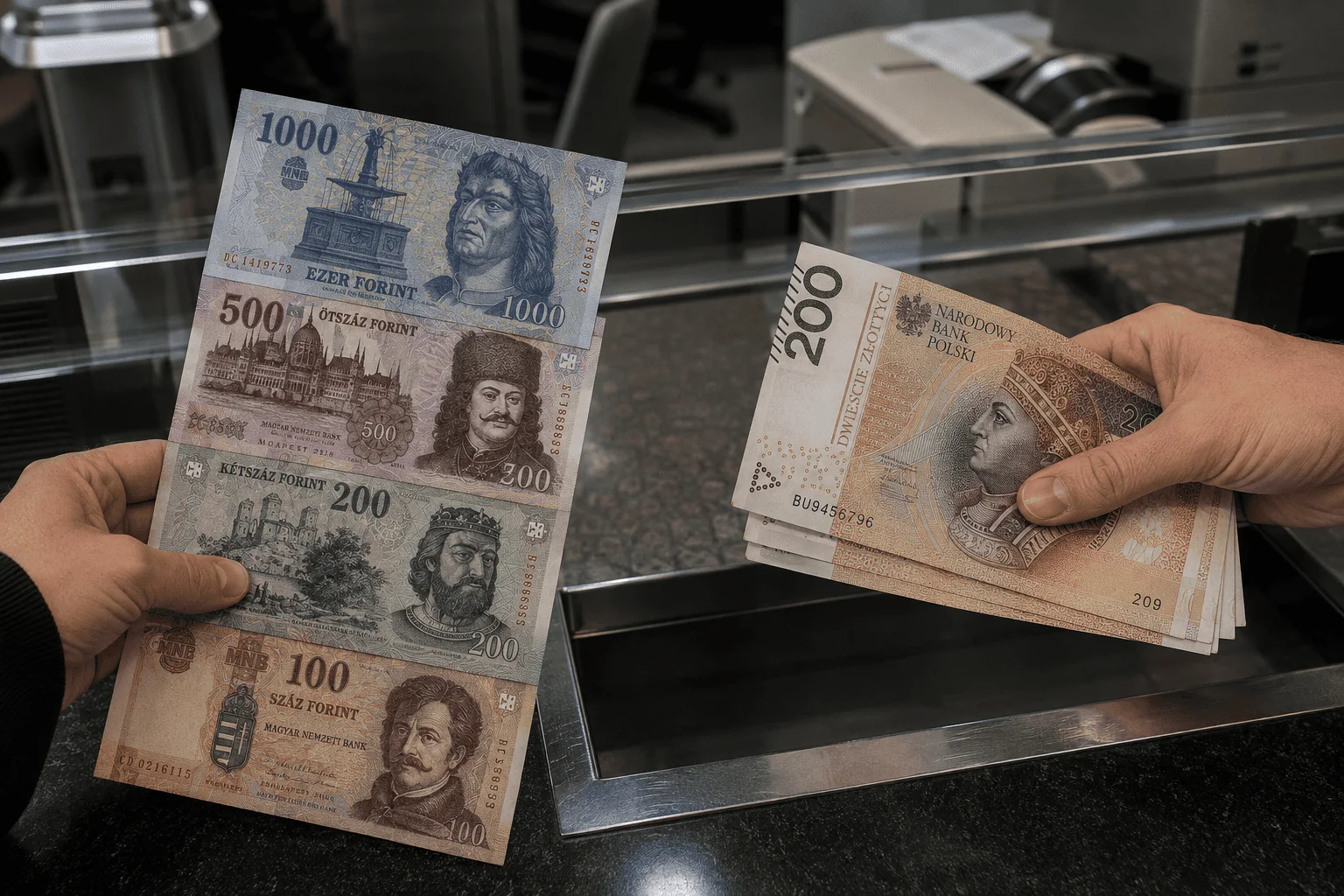
We exchange Hungarian forints (HUF) for złoty and złoty for forints at the Argentarii exchange office at Grzybowska 61 in the Wola district of Warsaw. The buy and sell rates are on the board before you reach the counter, and they are the same for five thousand forints and for five hundred thousand.
The forint is one of the currencies travellers bring back most often. In 2025 Hungarian hotels and guesthouses hosted 656,000 guests from Poland, 13.7 percent more than a year earlier (Hungarian Central Statistical Office, 5 May 2026). Below you will find a forint to złoty converter, the list of banknotes we accept and practical notes on paying in Hungary.
HUF/PLN rate
1 HUF = 0.0116 zł

Buying rate from this page. It is more favourable than the rate on the board in our branch, ask the cashier for it.
The currency you want to receive is temporarily out of stock. Rate reservation is unavailable. We buy this currency as usual, swap the direction to calculate.
A reservation holds the rate for 60 minutes. The rate from this page does not cover small denominations, damaged notes, old series or coins.
Current Hungarian forint exchange rate (HUF/PLN)
Our buy and sell rates for the forint are published on the agkantor.pl home page. We update them during opening hours. They are more favourable than the board, so ask the cashier for them when you exchange in person. The rate is the same regardless of the amount. For a larger sum, call ahead on +48 791 901 979.
The mid rate published by the National Bank of Poland on 7 August 2026 (table 152/A/NBP/2026) is 1.1741 zł per 100 forints. That is a reference rate, not an exchange office rate: at the counter the buy or sell rate applies, and the gap between them is the spread.
One detail is worth knowing when you compare converters: the NBP quotes the forint per 100 units, not per one. In table A the code HUF sits next to a multiplier of 100 and a rate of 1.1741, while services that convert to a single forint show 0.011741. It is the same value written differently.
The forint is quoted in table A, which is published every business day. That sets it apart from exotic currencies such as the Albanian lek, which appear only in table B and are updated once a week.
How much is 1,000 forints and how many forints do you get for 100 złoty
The figures below use the NBP mid rate of 7 August 2026 (table 152/A/NBP/2026, 100 HUF = 1.1741 zł). The exchange office rate differs from the mid rate, so treat these numbers as a reference point.
At the NBP mid rate, 1 HUF = 0.0119 zł (table 188/A/NBP/2026 of 28 September 2026), which means 1 zł = 83.9208 HUF.
At the Argentarii exchange office at Grzybowska 61 we buy HUF today at 0.0116 zł and sell at 0.0121 zł (website rate, updated 27.09.2026, 12:24).
| Amount | At NBP rate | You sell to us: you receive | You buy from us: you pay |
|---|---|---|---|
| 100 HUF | 1.19 zł | 1.16 zł | 1.21 zł |
| 500 HUF | 5.96 zł | 5.80 zł | 6.05 zł |
| 1,000 HUF | 11.92 zł | 11.60 zł | 12.10 zł |
| 5,000 HUF | 59.58 zł | 58.00 zł | 60.50 zł |
| 10,000 HUF | 119.16 zł | 116.00 zł | 121.00 zł |
| Amount in zł | At NBP rate | You buy from us: you receive |
|---|---|---|
| 100 zł | 8,392.08 HUF | 8,264.46 HUF |
| 500 zł | 41,960.39 HUF | 41,322.31 HUF |
| 1,000 zł | 83,920.78 HUF | 82,644.63 HUF |
Amounts are indicative and the rate changes during the day; at the counter the rate at the moment of the transaction applies. The website rate is more favourable than the rate on the board in our branch, ask the cashier for it. It does not cover small denominations, damaged notes, old series or coins.
The other way round:
- 10 zł ≈ 852 forints
- 50 zł ≈ 4,259 forints
- 100 zł ≈ 8,517 forints
- 200 zł ≈ 17,034 forints
- 500 zł ≈ 42,586 forints
- 1,000 zł ≈ 85,172 forints
One forint is worth about 1.2 grosz, which is why Hungarian price tags look higher than they are. The quickest mental shortcut is to divide the forint amount by 100. The result understates the złoty figure by roughly 15 percent, so it leaves you a margin. Dividing by 85 is more accurate: a 500 Ft ticket costs 5.87 zł, not 5 zł.
The home page also has a currency calculator. Enter an amount in forints and you see the result at our current rate.
What currency is used in Hungary
Hungary uses the forint. The ISO 4217 code is HUF and the domestic symbol is Ft, written after the amount: 5,000 Ft, not Ft 5,000. The euro is not an official currency in Hungary and is not legal tender there.
The forint entered circulation on 1 August 1946, after the most violent hyperinflation in monetary history. The Magyar Nemzeti Bank records monthly pengő inflation of 4.19 × 10¹⁶ percent in July 1946, and on 10 July prices were doubling in under eleven hours. At the changeover, 400,000 quadrillion pengő equalled a single forint.
The name itself is far older. It comes from the Florentine fiorino d’oro: Charles I of Hungary struck a gold coin under that name in the 1320s, and the 1946 currency reform went back to it.
The fillér, one hundredth of a forint, is long gone. The last fillér coin, the 50 fillér piece, was withdrawn on 30 September 1999 and the MNB no longer exchanges it. Prices today are quoted in whole forints.
If you are looking for the currency of Austria-Hungary, that is a different story: until 1892 it was the gulden, called forint in Hungarian, then the korona, then the pengő from 1927 to 1946, and only from 1946 the forint we use today.
One more thing that muddies search results: HUF is also the name of an American skate and streetwear brand founded in San Francisco in 2002. It has nothing to do with the currency.
Buying and selling forints in Warsaw
We buy and sell forints for cash with no commission. The HUF buy and sell rates are published on the home page and shown on the board in the office. You can buy forints before a trip to Budapest or Lake Balaton and sell whatever is left when you return.
The forint is a permanent item on our board, alongside the Czech koruna and the Romanian leu – currencies of Hungary’s neighbours that, like the forint, stayed outside the euro area. For a larger amount or less common denominations, call +48 791 901 979 a day ahead and we will have the cash ready at an agreed time.
There is one rate for everyone: the same for ten thousand forints and for five hundred thousand. We do not vary it by amount and we do not add commission on top of the board rate.
Which Hungarian banknotes we accept
Six denominations are in circulation: 500, 1,000, 2,000, 5,000, 10,000 and 20,000 forints. All of them belong to the series upgraded between 2014 and 2019, and we exchange all of them.
MNB issue dates for the upgraded designs: 10,000 Ft on 2 September 2014, 20,000 Ft on 25 September 2015, 2,000 and 5,000 Ft on 15 November 2016, 1,000 Ft on 24 August 2017 and 500 Ft on 4 July 2018. The 500 Ft note closed the upgrade programme, and the MNB has issued no new design since. The set of denominations has been stable for seven years.
We do not accept old designs, because they are no longer legal tender. MNB withdrawal dates: 1,000 Ft of the 1998 design on 31 August 2007, 200 Ft on 16 November 2009, 2,000 and 5,000 Ft on 31 July 2017, 20,000 Ft on 31 December 2017, the previous 1,000 Ft design on 31 October 2018, 500 Ft on 31 October 2019 and 10,000 Ft on 31 December 2019.
A withdrawn note does not lose its value straight away. The MNB exchanges it free of charge for 20 years from the withdrawal date at its cash desk at Kiss Ernő utca 1 in Budapest, and Hungarian banks and the post office do so for the first 3 years. In practice an old 10,000 Ft note can still be handed in at the MNB until the end of 2039, but no shop or exchange office will take it.
The 100 and 200 forint denominations exist only as coins today. The 200 forint note was withdrawn on 16 November 2009 and replaced by a bimetallic coin showing the Chain Bridge.
Forint coins and rounding to 5 forints
Coins in circulation are 5, 10, 20, 50, 100 and 200 forints. We do not accept coins – handling them costs more than they are worth, so small change is best spent before you leave. At 200 Ft, roughly 2.35 zł, a few coins in your pocket are real money.
Hungary withdrew the 1 and 2 forint coins on 1 March 2008 and introduced rounding of cash payments to the nearest five forints on the same day. The rule is fixed: totals ending in 1, 2, 6 and 7 round down, totals ending in 3, 4, 8 and 9 round up, and amounts ending in 0 or 5 stay as they are. Rounding applies to the whole bill rather than to individual prices, so a receipt can differ from the sum of its lines by a few forints.
Card payments are usually not rounded – the exact amount is taken from your account.
What moves the forint against the złoty
The forint and the złoty are two regional currencies outside the euro area, so they react to similar signals, though not always at the same pace. HUF/PLN is a cross rate calculated through the euro, which means the euro rate against the złoty also feeds into the price of the forint in Poland.
Four things shape forint quotes in 2026:
- The MNB policy rate. The Monetary Council cut the base rate to 5.75 percent on 21 July 2026. The rate had stood at 6.50 percent throughout 2025, moved to 6.25 percent in February 2026 and to 6.00 percent in June.
- Inflation. The Hungarian Central Statistical Office reported on 7 August 2026 that July prices rose 1.2 percent year on year – well below the central bank’s three percent target and the lowest reading in years.
- EU funds. On 29 May 2026 the European Commission released 16.4 billion euro to Hungary: 10 billion from the recovery facility and 6.4 billion in cohesion money, after 27 milestones on rule of law and public procurement were agreed. The sum is worth roughly 13 percent of Hungarian GDP.
- Trade and tourism. Hungary closed June 2026 with a trade surplus of 1,173 million euro and exports up 7.1 percent year on year (KSH, 30 July 2026). Tourism added 47.2 million guest nights in 2025, 5.1 percent more than a year earlier.
The forint from 2022 to 2026: from record weakness to recovery
The forint has floated freely since 26 February 2008, when the MNB removed its band against the euro. Since then the market sets the rate and the central bank defends no particular level.
The weakest point in the currency’s history was 13 October 2022, at 430.65 forints per euro according to European Central Bank reference rates. The energy crisis, double-digit inflation and frozen EU funds all pushed in the same direction.
The forint has recovered much of that ground. On 5 August 2026 the ECB published a rate of 362.08 forints per euro, and between May and August 2026 the rate moved between 349.53 on 16 June and 364.45 on 23 July. The gain of well over ten percent since autumn 2022 reflects lower inflation, a high real interest rate and the release of EU money.
For a traveller the takeaway is simple: the same amount in złoty buys noticeably fewer forints than in autumn 2022, but the rate is far steadier than it was then.
Will Hungary adopt the euro
Not for now. Hungary has been an EU member since 2004 but has not joined the euro area and does not take part in the ERM II exchange rate mechanism, which is a precondition.
In June 2026 Prime Minister Péter Magyar said the government aims to meet the euro entry criteria around 2030. That is a target for meeting the criteria, not a date for adopting the currency – at least two years in ERM II would still follow. Until further notice Hungary pays in forints and quotes prices in forints.
Cash or card – how people pay in Hungary
Cards work widely in Hungary. Since January 2021 merchants using online cash registers have been required to accept electronic payments, and the MNB payment systems report published in 2025 puts electronic settlement at 43 percent of purchases in that sector.
A rule pointing the other way has applied since 1 July 2025: the option to pay in cash was raised to constitutional status in Hungary by the fifteenth amendment to the Fundamental Law of 14 April 2025. A merchant must give you a way to pay in cash, with exceptions for services provided purely online and for unstaffed shops.
The detail that matters for travellers: this obligation covers forints only. Accepting foreign currency remains voluntary. A shop in Budapest must take your forints and has no obligation whatsoever to take euros. Where euros are accepted – some hotels and city-centre restaurants – the merchant sets the conversion rate, and it is usually unfavourable.
When you pay by card, the terminal may offer to settle in złoty rather than forints. That is dynamic currency conversion, and the rate then comes from the terminal operator rather than your bank. Choosing the amount in forints is normally cheaper. The same applies at cash machines.
Tipping is not compulsory; around 10 percent is customary. Restaurants with table service sometimes add a szervizdíj, a service charge, which should be announced in the menu and shown as a separate line on the bill.
How many forints to take and where to change them
It helps to have forints from your first hour in the country: airport transfer, water, a ticket. Budapest transport prices from the BKK tariff: a single ticket 500 Ft, about 5.87 zł, a block of ten tickets 4,500 Ft, a 24-hour pass 2,750 Ft, a 72-hour pass 5,750 Ft and a monthly Budapest pass 8,950 Ft, roughly 105 zł.
Changing money in Poland before you travel has one advantage: you see the rate before you spend anything and can compare it calmly. Tourist kiosks in central Budapest advertise “0% commission”. No commission says nothing about the rate, and the rate is where an exchange point makes its money. Ask how many forints you will receive in hand for a specific amount and compare that number rather than the slogan in the window.
If forints are left over when you get back, we will buy them – current series notes in all six denominations.
How much cash you can take to Hungary
Poland and Hungary are both in the European Union, so the EU cash declaration duty does not apply between them. There are also no EU-wide rules on carrying cash inside the Union, and individual countries may set their own, so for larger amounts it is worth checking the rules of the countries you travel through.
The declaration duty applies when crossing the external border of the Union and covers amounts from 10,000 euro or the equivalent, in both directions. It comes from Article 3 of Regulation (EU) 2018/1672, and the Hungarian tax and customs administration NAV applies it the same way the Polish one does.
The limit counts more than banknotes and coins: travellers cheques, cheques with no named payee, gold coins of at least 900 fineness and bullion of at least 995 fineness all count towards it. That surprises people carrying bullion – if you are planning to sell gold, we will value it here in Warsaw and you will not need to carry it anywhere.
How exchanging forints works at our counter
It takes a few minutes. You give the amount, we confirm the rate, count the cash in front of you and pay out on the spot. There is no commission. We earn only on the difference between the buy and sell rate.
An identity document is required only for transactions equivalent to 15,000 euro or more, under anti-money-laundering rules. The office operates on the basis of an entry in the register of currency exchange activity kept by the National Bank of Poland.
You can also reserve a rate for one hour free of charge through the contact form. The reservation commits you to nothing – we simply hold the agreed rate for 60 minutes.
Argentarii exchange office – Grzybowska 61, Warsaw
The office is at Grzybowska 61, in the Platinum Towers passage in the Wola district, a few minutes on foot from the Rondo Daszyńskiego metro station. We are open seven days a week: Monday to Friday 9:00–21:00, Saturday 10:00–20:00, Sunday 11:00–20:00. Phone: +48 791 901 979.
We serve customers in Polish, English, Ukrainian and Russian. We do not accept payment cards. There is parking on site, and the entrance is wheelchair accessible.
Besides the forint we exchange 24 currencies, and we also buy gold – valuation is free.
Frequently asked questions about exchanging Hungarian forints
How many forints will I get for 100 zł?
At the NBP mid rate of 7 August 2026 (table 152/A/NBP/2026), 100 zł works out to about 8,500 forints. At the counter the sell rate applies, so the amount will be slightly lower. We will give you the exact figure at the window or by phone on +48 791 901 979.
How much is 1,000 forints?
About 11.74 zł at the NBP mid rate of 7 August 2026. Ten thousand forints comes to roughly 117 zł and twenty thousand to about 235 zł.
How many forints is 1 zł?
About 85 forints. The other way round, one forint is just under 1.2 grosz, which is why Hungarian prices look high at first glance.
Should I pay in forints or euros in Hungary?
In forints. The euro is not legal tender in Hungary and a shop has no obligation to accept it; where it is accepted, the merchant sets the conversion rate. Since 1 July 2025 the option to pay in cash has been a constitutional right in Hungary, but for forints only.
Which Hungarian banknotes do you accept?
All six denominations of the current series: 500, 1,000, 2,000, 5,000, 10,000 and 20,000 forints. We do not accept old designs, because they are no longer legal tender – only the Magyar Nemzeti Bank in Budapest exchanges those, for 20 years from the withdrawal date.
Is it better to buy forints in Poland or in Hungary?
It is worth having forints for the first expenses before you go: airport transfer, a ticket, a coffee. The rest can be changed locally, but rates at tourist kiosks in central Budapest are often markedly worse, and a zero commission sign says nothing about the rate. Always compare the amount you receive in hand.
Do you buy forints back after a trip to Hungary?
Yes, we buy back current series notes in all six denominations. We do not accept coins – handling them costs more than they are worth, so small change is best spent before you leave.