


Canadian Dollar (CAD) – Exchange Rate and Cash Exchange in Warsaw
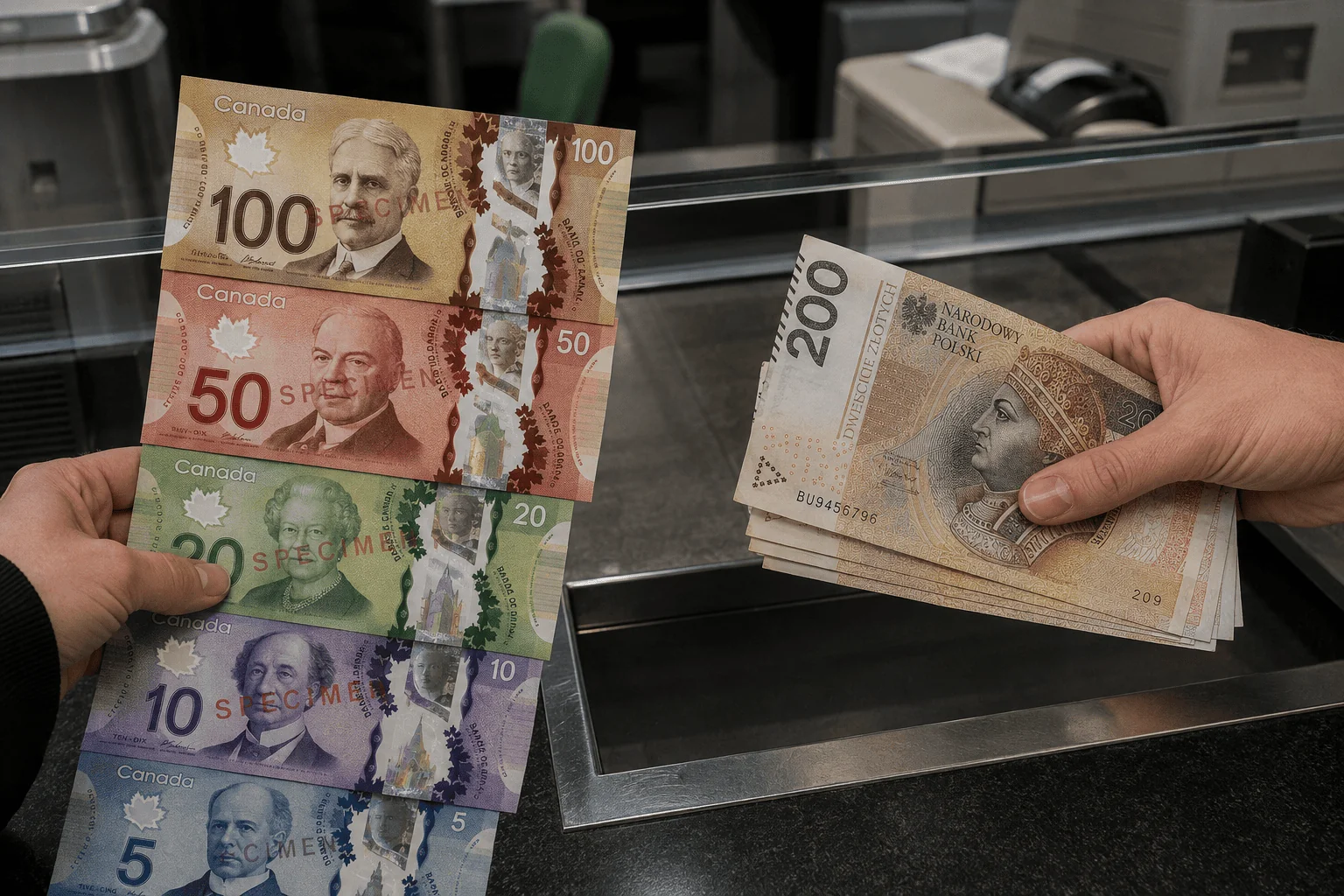
We buy and sell Canadian dollars for złoty at the Argentarii kantor at Grzybowska 61 in Warsaw. The current CAD/PLN rate is on the board at the counter and in the calculator above. It is the same rate whether you exchange 100 or 5,000 Canadian dollars.
Canadian dollars usually reach Poland from travel, seasonal work or family — close to a million Canadians have Polish roots. Below you will find conversions for typical amounts, the list of banknotes we accept, and an explanation of why Canadian one- and two-dollar denominations cannot be exchanged here in any form.
CAD/PLN rate
1 CAD = 2.6900 zł

Buying rate from this page. It is more favourable than the rate on the board in our branch, ask the cashier for it.
The currency you want to receive is temporarily out of stock. Rate reservation is unavailable. We buy this currency as usual, swap the direction to calculate.
A reservation holds the rate for 60 minutes. The rate from this page does not cover small denominations, damaged notes, old series or coins.
Current Canadian dollar exchange rate (CAD/PLN)
We update our buy and sell rates for the Canadian dollar during the day, in line with the market. Live values are in the currency table on our home page. That rate is more favourable than the board at the counter on Grzybowska, so ask the cashier for it.
For reference, the mid rate published by the National Bank of Poland on 7 August 2026 (table 152/A/NBP/2026) was 2.6618 PLN per Canadian dollar. The NBP rate is a benchmark for accounting and customs, not the price at which you buy cash — kantors and banks add their spread to it.
It is worth knowing where the CAD/PLN rate comes from. At 11:00 the NBP fixes the euro against the złoty, then calculates the other table A currencies, including the Canadian dollar, through market euro rates. The CAD/PLN pair is therefore not quoted directly but derived as a cross rate. That is one reason the spread on the Canadian dollar tends to be wider than on the euro or the US dollar.
How much is 50 CAD in złoty
At the NBP mid rate, 1 CAD = 2.7182 zł (table 188/A/NBP/2026 of 28 September 2026), which means 1 zł = 0.3679 CAD.
At the Argentarii exchange office at Grzybowska 61 we buy CAD today at 2.6900 zł; selling this currency is temporarily unavailable (updated 29.09.2026, 09:42).
| Amount | At NBP rate | You sell to us: you receive | You buy from us: you pay |
|---|---|---|---|
| 1 CAD | 2.72 zł | 2.69 zł | n/a |
| 10 CAD | 27.18 zł | 26.90 zł | n/a |
| 100 CAD | 271.82 zł | 269.00 zł | n/a |
| 500 CAD | 1,359.10 zł | 1,345.00 zł | n/a |
| 1,000 CAD | 2,718.20 zł | 2,690.00 zł | n/a |
| Amount in zł | At NBP rate | You buy from us: you receive |
|---|---|---|
| 100 zł | 36.79 CAD | n/a |
| 500 zł | 183.95 CAD | n/a |
| 1,000 zł | 367.89 CAD | n/a |
Amounts are indicative and the rate changes during the day; at the counter the rate at the moment of the transaction applies. The website rate is more favourable than the rate on the board in our branch, ask the cashier for it. It does not cover small denominations, damaged notes, old series or coins.
For the exact amount at our current buying and selling rate, use the calculator above.
How much is 100 Canadian dollars, and how many CAD for 100 złoty
The conversions below use the NBP mid rate of 2.6618 PLN from 7 August 2026. A kantor rate differs from it by the spread, so treat these figures as indicative.
- 1 Canadian dollar ≈ 2.66 PLN
- 5 CAD ≈ 13 PLN
- 10 CAD ≈ 27 PLN
- 20 CAD ≈ 53 PLN
- 50 CAD ≈ 133 PLN
- 100 CAD ≈ 266 PLN
- 200 CAD ≈ 532 PLN
- 500 CAD ≈ 1,331 PLN
- 1,000 CAD ≈ 2,662 PLN
- 2,000 CAD ≈ 5,324 PLN
- 5,000 CAD ≈ 13,309 PLN
The other way round: 100 PLN gets you about 38 Canadian dollars, 500 PLN about 188 CAD, and 1,000 PLN about 376 CAD. One złoty is roughly 0.38 Canadian dollars.
A quick way to convert in a shop in Toronto or Vancouver: multiply the Canadian amount by two and a half. A price of 40 CAD comes out at 100 PLN, while the real figure is about 106 PLN. The shortcut understates the result by a few percent, so it leaves you a margin rather than a surprise.
For an exact figure, use the calculator on the home page or ask at the counter. For a larger transaction, call +48 791 901 979 a day ahead and we will have the cash ready at an agreed time.
Canadian versus US dollar – two currencies, one symbol
Both are written with the dollar sign, but they are separate currencies issued by separate central banks. The Canadian dollar carries the ISO code CAD and is issued by the Bank of Canada; the American one is USD, issued by the Federal Reserve. When the two need to be told apart, the Canadian one is written C$, CA$ or CAD$.
The gap in value is substantial. On 7 August 2026 one US dollar bought 1.3943 Canadian dollars at the Bank of Canada rate. A price tag of “$50” in a Canadian shop therefore means 50 CAD, or about 36 US dollars. Read as US dollars, it overstates the cost by nearly forty percent.
At the counter this has a simple consequence: the two currencies have completely different rates, so always check which one you are holding. Canadian notes are polymer, with a transparent window, and they behave differently when folded from American paper notes. The rate for the other currency is on our US dollar exchange page.
The US dollar is not legal tender in Canada. Shops sometimes accept it voluntarily, but then they set their own rate, and it is usually worse than a kantor. Under the Canadian Currency Act, only Canadian coins and Bank of Canada notes are legal tender.
What currency is used in Canada
Canada uses the Canadian dollar, divided into 100 cents. It is issued by the Bank of Canada, created by an act that received royal assent on 3 July 1934 and operating since March 1935; the bank has been publicly owned since 1938.
Banknotes in circulation come in 5, 10, 20, 50 and 100 dollars. One and two dollars exist only as coins. The one-dollar coin with a loon, known in Canada as the loonie, entered circulation on 30 June 1987 and replaced a note that had circulated since 1870. The two-dollar coin with a polar bear, the toonie, followed on 19 February 1996. Both nicknames are in everyday use and you will hear them at every till.
Circulation coins are 5, 10 and 25 cents plus 1 and 2 dollars. The penny left circulation in 2013: the last one was struck on 4 May 2012 and the Royal Canadian Mint stopped distributing pennies on 4 February 2013. The reason was mundane — each coin cost 1.6 cents to make. The penny formally remains legal tender, but cash payments are rounded to the nearest five cents, while card payments are still counted to the cent.
There is one more rule that surprises people at the till: Canadian law caps how many coins a merchant has to accept in a single transaction. The Currency Act sets a limit of 40 dollars for coins of 2 to 10 dollars, 25 dollars for one-dollar coins and 5 dollars for nickels. Paying a bill with two hundred loonies simply will not work.
Canadian banknotes withdrawn from circulation – what expired and what did not
This is the question that comes up most often at the counter, because the Canadian rules differ from what most countries have accustomed us to.
Since 1 January 2021 the 1, 2, 25, 500 and 1,000 dollar notes have ceased to be legal tender — across every Bank of Canada series. The basis is the Order Calling in Certain Notes (SOR/2019-146), registered on 22 May 2019 and issued after the 21 June 2018 amendment to the Currency Act.
Those notes did not lose their value, though. The Bank of Canada redeems them at face value with no deadline, directly or through a Canadian bank. You cannot pay with them in a shop, but they are not waste paper either.
The key distinction is this: denominations were withdrawn, not series. Older paper 5, 10, 20, 50 and 100 dollar notes, including the Birds of Canada series of 1986–1991 and Canadian Journey of 2001–2006, remain legal tender. The Bank of Canada states plainly that there are no plans to remove legal tender status from any further denominations.
Practice differs from the rule, however. No Canadian law obliges a merchant to accept cash, so a cashier in Montreal may refuse a paper twenty from 1991 even though it is formally valid. If you keep old Canadian notes at home, that is worth knowing before you travel.
Which Canadian banknotes we accept
We buy and sell notes from the current polymer series: 5, 10, 20, 50 and 100 Canadian dollars. Canada completed its switch to polymer on 7 November 2013, when the last two denominations entered circulation — the five and the ten. The hundred came first (14 November 2011), then the fifty (26 March 2012) and the twenty (7 November 2012). Australia did it first, back in the 1990s, but Canada was in the second wave of countries to convert an entire series.
The vertical ten with Viola Desmond, introduced on 19 November 2018, deserves a separate mention. It is Canada’s first vertical banknote and the first to feature a Canadian woman — an activist from Nova Scotia who in 1946 refused to leave the whites-only section of a cinema. We accept it exactly as we do the horizontal ten.
We do not accept notes that have lost legal tender status: the 1, 2, 25, 500 and 1,000 dollar denominations. Only the Bank of Canada redeems those.
We do not accept coins — the cost of processing them exceeds their value, so Canadian quarters, loonies and toonies are best spent before you leave. That leads to a practical conclusion: Canadian one and two dollars cannot be exchanged here in any form, because as notes they are no longer valid and as coins we do not buy them.
We accept undamaged notes: no tears, tape, writing or heavy soiling. Polymer is tougher than paper, but creases and worn printed layers do occur.
The Bank of Canada has announced two new notes. A vertical twenty featuring King Charles III is expected to enter circulation in early 2027, and a new five with Terry Fox, announced on 16 December 2024, will follow it with no date set. Until then the 2011–2013 polymer series and the 2018 vertical ten remain in circulation.
What moves the Canadian dollar
The Canadian dollar is called a commodity currency, and the label is not empty. Canada is the world’s fourth largest crude oil producer, and in 2025 it exported 3.9 million barrels a day to the United States, worth 126.1 billion Canadian dollars — about 90 percent of all Canadian crude exports.
The dependence on commodities is often overstated, though. Bank of Canada research shows that sensitivity to commodity prices explains only part of the swings, and the bank attributed the weakening of late 2024 and early 2025 mainly to uncertainty around trade policy rather than to oil.
In practice three things act on the CAD/PLN rate at once:
- The interest rate gap. The Bank of Canada has held its policy rate at 2.25 percent since 30 October 2025 and kept it there at five consecutive meetings, most recently on 15 July 2026. The next decision comes on 2 September 2026.
- US trade policy. In 2025, 72.5 percent of Canadian merchandise exports went to the United States, down from 76.3 percent a year earlier. At that level of concentration, every change in trading conditions shows up in the rate.
- Oil prices. In April 2026 a barrel cost around 120 dollars after escalation in the Middle East, fell to roughly 75 dollars in June, then rose again.
Remember the other side of the pair as well. Because CAD/PLN is calculated as a cross rate, what happens to the złoty against the euro and the dollar also feeds into the result. The Canadian dollar can strengthen against the US dollar and still cost fewer złoty in Warsaw than a week earlier.
We do not forecast exchange rates and we do not advise on when to buy — that is not a kantor’s role. What we can do is show how the rate has behaved so far and explain the mechanism.
The Canadian dollar rate in 2024–2026
The reference points below come from the Bank of Canada’s daily USD/CAD rates. The higher the number, the weaker the Canadian dollar against the American one.
- 2 January 2024 — 1.3316. The strongest Canadian dollar in the whole period.
- 27 December 2024 — 1.4416. The close of a year of clear weakening.
- 3 February 2025 — 1.4603. The weakest point of the cycle, on the day the first tariff order was paused.
- 16 June 2025 — 1.3558. A mid-year rebound.
- 29 January 2026 — 1.3515. The strongest point of 2026.
- 24 June 2026 — 1.4234. Pressure returning ahead of the August tariff deadline.
- 7 August 2026 — 1.3943.
Recent weeks have been good for the Canadian dollar. On 7 August 2026 it reached an eight-week high after labour market data: 75,100 new jobs in July against an expected 16,500, and unemployment at 6.4 percent, the lowest in two years.
For comparison, the NBP rate on the same day was 2.6618 PLN per Canadian dollar. Over the past two years CAD has cost roughly 2.60 to 2.90 PLN in Poland, so the difference between a better and a worse moment runs into the low tens of percent on larger amounts. That is not a basis for predicting what comes next.
US tariffs and the Canadian dollar
This is the topic that has moved the CAD rate most since the start of 2025, and it deserves its own section because the situation has changed several times.
The tariffs imposed in March 2025 under the IEEPA — 25 percent on Canadian goods, 10 percent on energy, rising to 35 percent in August 2025 — are no longer in force. On 20 February 2026 the US Supreme Court ruled that the IEEPA provides no basis for imposing tariffs, and collection ended on 24 February 2026.
Section 232 tariffs, which rest on a different legal basis, remain: 50 percent on steel, aluminium and some copper products, and 25 percent on passenger vehicles for their non-US content. According to the Bank of Canada, Canadian steel exports halved, and aluminium was 50 percent below 2024 levels by the middle of 2025.
The newest piece: on 20 July 2026 additional tariffs of 50 percent were announced on selected Canadian goods under Section 338 of the Tariff Act of 1930. They take effect on 19 August 2026 and cover about 20 billion dollars of imports — among them motor vehicles, alcoholic beverages and dairy. CUSMA origin does not exempt goods from these tariffs; energy, potash, fish and some critical minerals are excluded.
For someone bringing a few hundred Canadian dollars to a kantor, the takeaway is simple: the CAD rate reacts to trade headlines faster than to macroeconomic data. In the weeks around such deadlines, swings tend to be larger than usual.
Buying and selling Canadian dollars in Warsaw
Canadian dollars can be bought and sold for cash in Poland, though not in every kantor. It is a second-tier currency: brought back from trips and from family, rarely held as a reserve, so many outlets do not carry it or keep only a token amount in the till.
We buy and sell Canadian dollars both ways. The CAD buy rate is published on the board and in the calculator. A zero in the sell column means only that we do not have that currency in the till on a given day. For a larger amount or less common denominations, call +48 791 901 979 a day ahead and we will have the cash ready at an agreed time.
We charge no commission. The rate is the same whether you exchange 200 or 2,000 Canadian dollars. There are no amount thresholds and no separate rates for regular customers.
We exchange other currencies too; the full list is on our currency exchange page. The most frequent requests are euro, US dollars and hryvnia, but we also handle the Australian dollar and rarer currencies such as the Mexican peso and the Japanese yen.
How much cash can you bring into and out of Canada
Canada sets no limit on the amount you may carry across the border — what it sets is a duty to declare. The Canada Border Services Agency requires a declaration when you carry funds worth 10,000 Canadian dollars or more, and this applies both on entry and on exit.
Everything counts towards the threshold together: cash in Canadian dollars and in foreign currencies, cheques, travellers cheques, money orders, promissory notes and securities. The basis is the Proceeds of Crime (Money Laundering) and Terrorist Financing Act. Failing to report can result in the officer seizing the funds.
It is worth noting how the rules mirror each other. Leaving Poland for a destination outside the European Union, you declare amounts from 10,000 euro. Flying to Canada with cash, you may therefore be subject to two separate reporting duties: the Polish one on leaving the EU and the Canadian one on arrival.
Cash or card – how people pay in Canada
Canada is a country of cards and contactless payments, but cash has not disappeared. The Bank of Canada’s 2024 methods-of-payment survey found that cash covered 21 percent of transactions by number and 11 percent by value — roughly one purchase in five, usually a small one. The average Canadian carried 156 dollars, with a median of 75 dollars.
The practical conclusion for a traveller is straightforward: a few hundred Canadian dollars in your pocket covers small expenses, taxis, tips and places where the terminal is down. There is no point carrying the rest in cash.
The second thing that surprises first-time visitors is tax added at the till. Shelf prices usually exclude sales tax, and the rate depends on the province: 5 percent GST in Alberta and the northern territories, 13 percent HST in Ontario, 14 percent in Nova Scotia after the reduction of 1 April 2025, and 15 percent in New Brunswick, Newfoundland and Prince Edward Island. In British Columbia, Manitoba, Saskatchewan and Quebec a separate provincial tax comes on top of the 5 percent GST.
Tipping is a custom rather than an obligation. The usual rate in a table-service restaurant is around 15 to 20 percent, though Canadians themselves increasingly complain about rising expectations. In an Angus Reid Institute survey from early 2023, 83 percent of respondents said too many places ask for a tip.
The Canadian Maple Leaf – a gold coin with a 50 dollar face value
Canada is home to one of the most recognisable bullion coins in the world. The Royal Canadian Mint has struck the Canadian Maple Leaf without interruption since 1979, and total sales have passed 25 million ounces.
The one-ounce gold coin weighs 31.11 grams, is 999.9 fine, measures 30 millimetres across, and carries a face value of 50 Canadian dollars. That face value is purely formal. The coin is worth what the metal is worth, many times more. The 2026 obverse bears the effigy of King Charles III. Fractional versions are struck too, and since 1988 there has also been a silver Maple Leaf, 999.9 fine, with a face value of 5 dollars.
If you own one, it is not a matter for the currency counter. We handle these through gold buying and coin buying, where the valuation follows the metal content rather than the figure struck on the reverse.
How exchanging Canadian dollars works at our counter
The exchange takes a few minutes. You come to the counter, say how much you want to exchange and in which direction, and we give you the rate and the amount payable before the transaction. There is no commission and nothing is added at the end.
For amounts up to the equivalent of 15,000 euro no identity document is needed. Above that threshold, anti-money-laundering rules require customer identification — a statutory obligation, the same in every kantor in Poland. Bring an ID card or passport in that case.
You receive a confirmation after the transaction. Count the cash at the counter, because we can only handle claims on the spot.
Argentarii kantor – Grzybowska 61, Warsaw
We are at Grzybowska 61 in the Wola district, a few minutes from Rondo Daszyńskiego. Open Monday to Friday 9:00–21:00, Saturday 10:00–20:00, Sunday 11:00–20:00.
We serve customers in Polish, English, Ukrainian and Russian. We do not accept payment cards. There is parking on site, and the entrance is wheelchair accessible.
Phone: +48 791 901 979. The address, directions and a map are on our contact page. Besides currency exchange we run gold buying and coin buying.
Frequently asked questions about exchanging Canadian dollars
How much is 100 Canadian dollars in złoty?
At the NBP mid rate of 2.6618 PLN from 7 August 2026, 100 Canadian dollars is about 266 złoty. A kantor rate differs from the NBP mid rate by the spread, so you will see the exact amount in the calculator on our home page or at the counter on Grzybowska 61.
How many Canadian dollars will I get for 100 złoty?
About 38 Canadian dollars at the NBP rate from 7 August 2026. For 500 złoty that is roughly 188 CAD, and for 1,000 złoty about 376 CAD. One złoty corresponds to approximately 0.38 Canadian dollars.
What is the difference between the Canadian and the US dollar?
They are two separate currencies of two central banks, written with the same dollar sign. The Canadian one carries the code CAD and is issued by the Bank of Canada; the American one is USD, issued by the Federal Reserve. On 7 August 2026 one US dollar bought 1.3943 Canadian dollars, so a price of “$50” in Canada is about 36 US dollars.
Are old Canadian dollars still valid?
It depends on the denomination. Since 1 January 2021 the 1, 2, 25, 500 and 1,000 dollar notes of every series have ceased to be legal tender, but the Bank of Canada redeems them at face value with no deadline. Older paper 5, 10, 20, 50 and 100 dollar notes remain valid, although a merchant in Canada is under no obligation to accept cash.
Which Canadian banknotes do you accept?
We buy and sell undamaged polymer notes of 5, 10, 20, 50 and 100 Canadian dollars, including the vertical ten with Viola Desmond. We do not accept denominations withdrawn from circulation, and we do not accept coins, so Canadian loonies and toonies are not something we buy.
What currency is used in Canada?
The Canadian dollar, code CAD, divided into 100 cents. Notes of 5, 10, 20, 50 and 100 dollars circulate, along with coins of 5, 10 and 25 cents and 1 and 2 dollars. The penny left circulation in 2013 and cash payments are rounded to the nearest five cents.
Can you pay with US dollars in Canada?
The US dollar is not legal tender in Canada. Some shops and hotels in border cities accept it voluntarily, but then they set their own rate and it usually works out worse than a kantor. Only Canadian coins and Bank of Canada notes are legal tender.